
LESSON 05: MY EXPERIENCES

Let’s talk about things you have done and experienced! 🌍✨
🎯 WHAT WILL YOU LEARN?
By the end of this lesson, you will be able to:
- talk about things you have done in your life
- use the Present Perfect to talk about experiences
- make affirmative and negative sentences
- ask questions with Have you ever…?
- use ever and never
- talk about interesting experiences in a simple way
Ready? Let’s talk about your experiences! 🌟
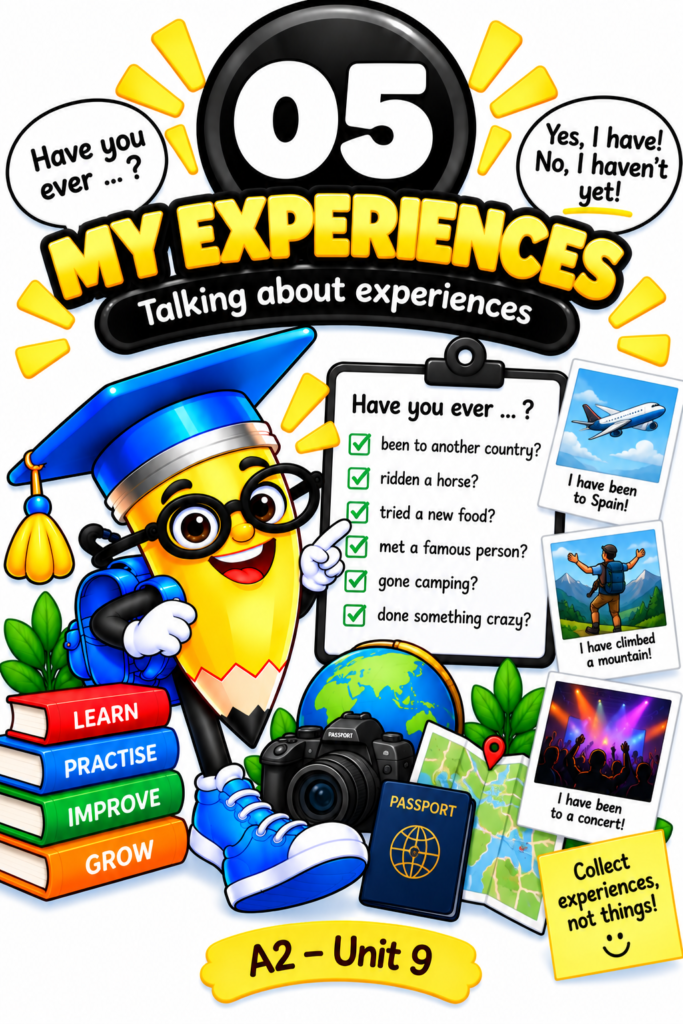
🌟 EXPERIENCES
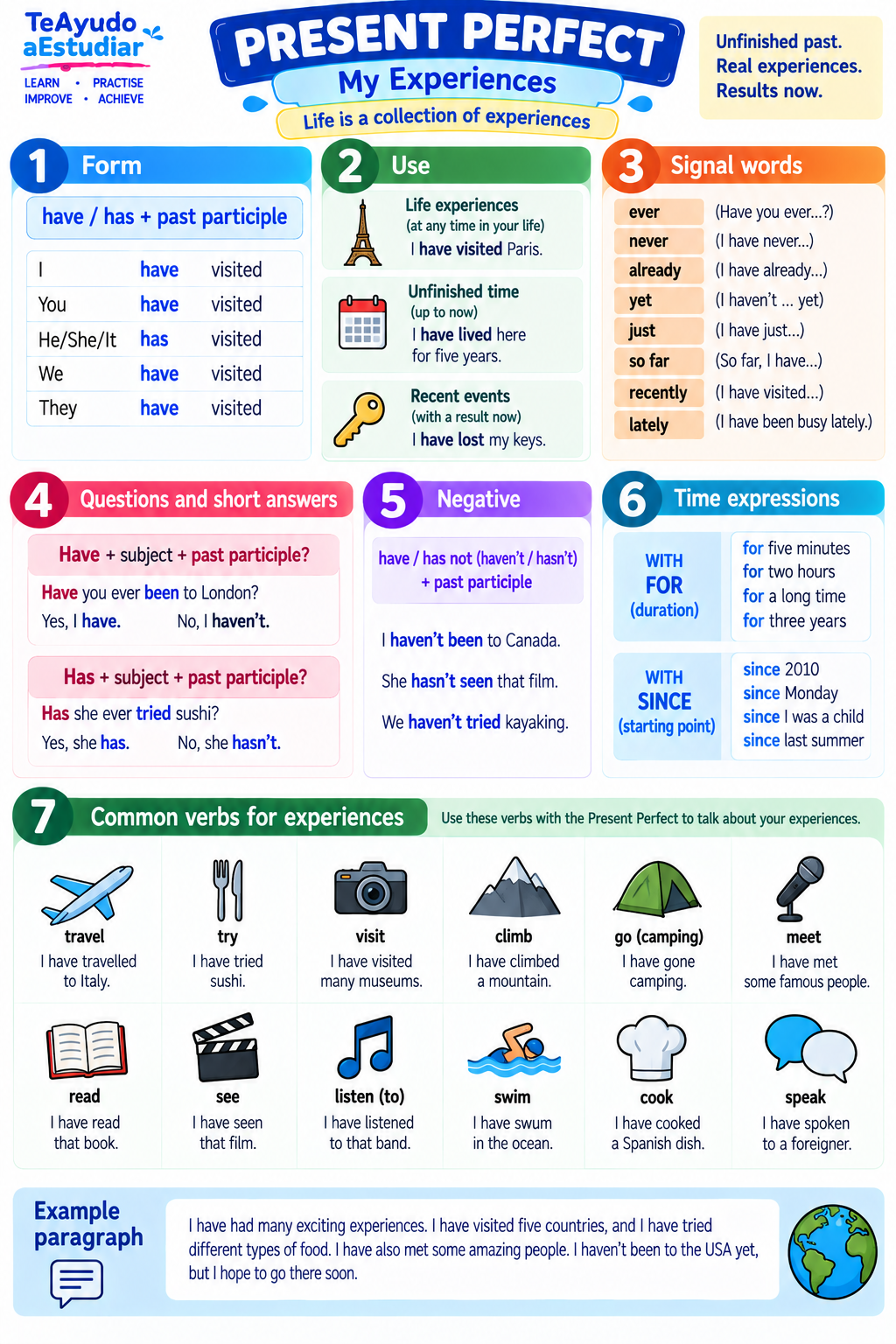
We can use the Present Perfect to talk about experiences in our lives. We don’t need to say exactly when they happened.
| Subject | Have / Has | Past participle |
|---|---|---|
| I | have | visited |
| you | have | visited |
| he / she | has | visited |
| we | have | visited |
| they | have | visited |
Examples:
- I have visited Madrid.
- She has tried sushi.
- We have seen a famous singer.
- They have travelled by plane.
🧩 HAVE OR HAS?
Use have with I, you, we and they. Use has with he, she and it.
| Subject | Example |
|---|---|
| I | I have visited London. |
| You | You have tried skiing. |
| He | He has ridden a horse. |
| She | She has seen snow. |
| We | We have eaten Italian food. |
| They | They have travelled by train. |
❌ I HAVEN’T…
To say that something has not happened in your life, use haven’t or hasn’t.
- I haven’t visited Paris.
- She hasn’t tried surfing.
- We haven’t travelled by plane.
❓ HAVE YOU EVER…?
We use Have you ever…? to ask if someone has had an experience at any time in their life.
| Question | Answer |
|---|---|
| Have you ever visited London? | Yes, I have. |
| Have you ever ridden a horse? | No, I haven’t. |
| Have you ever tried sushi? | Yes, I have. |
| Has she ever travelled by plane? | Yes, she has. |
🔄 EVER OR NEVER?
Ever is common in questions:
Have you ever seen snow?
Never means that something has not happened at any time in your life.
I have never seen snow.
Be careful: never already has a negative meaning. We don’t say I haven’t never…
📖 READ: EXPERIENCES TO REMEMBER
Read about three friends and some things they have done.
Emma, Leo and Sam are talking about their experiences. Emma has visited London twice. She has also ridden a horse and tried sushi. Leo has travelled by plane many times, but he has never ridden a horse. He has visited the mountains with his family and has taken lots of photos there. Sam has never travelled by plane, but she has been to the beach many times. She has also tried surfing. The three friends have different experiences, but they all enjoy trying new things.
🔎 CHECK YOUR UNDERSTANDING
- How many times has Emma visited London?
- What has Emma tried?
- Has Leo ever ridden a horse?
- Where has Leo been with his family?
- Has Sam travelled by plane?
- What has Sam tried?
✏️ PRACTISE: MY EXPERIENCES
Complete the sentences with information about you.
- I have visited…
- I have tried…
- I have seen…
- I have travelled…
- I have never…
🎯 YOUR EXPERIENCE LIST
Write five sentences about things you have done in your life. Use have or has and a past participle.
Try to include one sentence with never.
🗣️ ASK A FRIEND
Ask a friend these questions:
- Have you ever travelled by plane?
- Have you ever visited another country?
- Have you ever ridden a horse?
- Have you ever tried a new food?
- Have you ever seen snow?
🏆 A2 CHALLENGE
Write a short paragraph about your life experiences. Include at least four Present Perfect sentences and one sentence with never.
Then write one question beginning with Have you ever…? for a friend.
🎮 GAMES
Practise the Present Perfect and talking about experiences with these games:
¿Para qué usamos el Present Perfect?
En esta lección lo usamos principalmente para hablar de experiencias que hemos tenido en nuestra vida, sin decir exactamente cuándo ocurrieron.
¿Cómo formo el Present Perfect?
Usamos have/has + past participle: I have visited London. / She has tried sushi.
¿Cuándo uso have y cuándo has?
Usamos have con I, you, we y they. Usamos has con he, she e it.
¿Qué significa Have you ever…?
Significa algo parecido a “¿Has… alguna vez?”. Se utiliza para preguntar por experiencias.
¿Qué significa never?
Never significa “nunca”. Por ejemplo: I have never ridden a horse.
¿Puedo usar never con haven’t?
No. Never ya tiene significado negativo. Decimos I have never seen snow, no I haven’t never seen snow.
¿Tengo que decir cuándo ocurrió la experiencia?
No en este uso del Present Perfect. Lo importante es la experiencia, no el momento exacto.
¿Tengo que aprender todos los participios irregulares ahora?
No. Empieza con los verbos más frecuentes y practica sus formas poco a poco.
📥 Fichas descargables


📝 Resumen
In this lesson, you have learned how to use the Present Perfect to talk about life experiences. You can now make simple sentences with have/has + past participle, ask questions with Have you ever…? and use ever and never to talk about things you have or haven’t done.
Recursos Premium Próximamente
Materiales más completos para aprender, practicar y avanzar.
Descubre nuestros cuadernos, packs de fichas y materiales exclusivos, creados para profundizar en cada asignatura y trabajar de forma autónoma.
Cuadernos educativos
Teoría, ejercicios y actividades organizadas para aprender paso a paso
Desde 4.90 €
Packs de fichas
Cientos de fichas listas para imprimir, organizadas por asignaturas y cursos.
Desde 1.99 €
Recursos Premium
Material exclusivo de refuerzo y exámenes con soluciones
Desde 1.99 €
¿Quieres aprender más rápido?
Suscríbete gratis a nuestra newsletter con el código QR o haciendo clic en el botón rojo y recibe recursos educativos, ejercicios, exámenes…
Sin spam. Cancela cuando quieras.

TeAyudoAEstudiar
Plataforma educativa para Primaria, ESO y docentes.
Asignaturas
Matemáticas
Inglés
Lengua
Ciencias Sociales
Recursos
Fichas
Exámenes
Juegos educativos
Recursos Premium
Empresa
Sobre nosotros
Aviso legal
Privacidad
Contacto
© 2026 TeAyudoAEstudiar · Todos los derechos reservados.
Creado por docentes🧡 para ayudarte a aprender.