
LESSON 04: PASSIVE VOICE

Let’s learn how things are made! 🛠️
🎯 WHAT WILL YOU LEARN?
By the end of this lesson, you will be able to:
- understand what the passive voice is
- recognise simple passive sentences
- use am, is and are + past participle
- talk about how everyday things are made
- say what happens to things without focusing on who does it
- write simple sentences using the passive voice
Ready? Let’s discover how things are made! 🔧😊
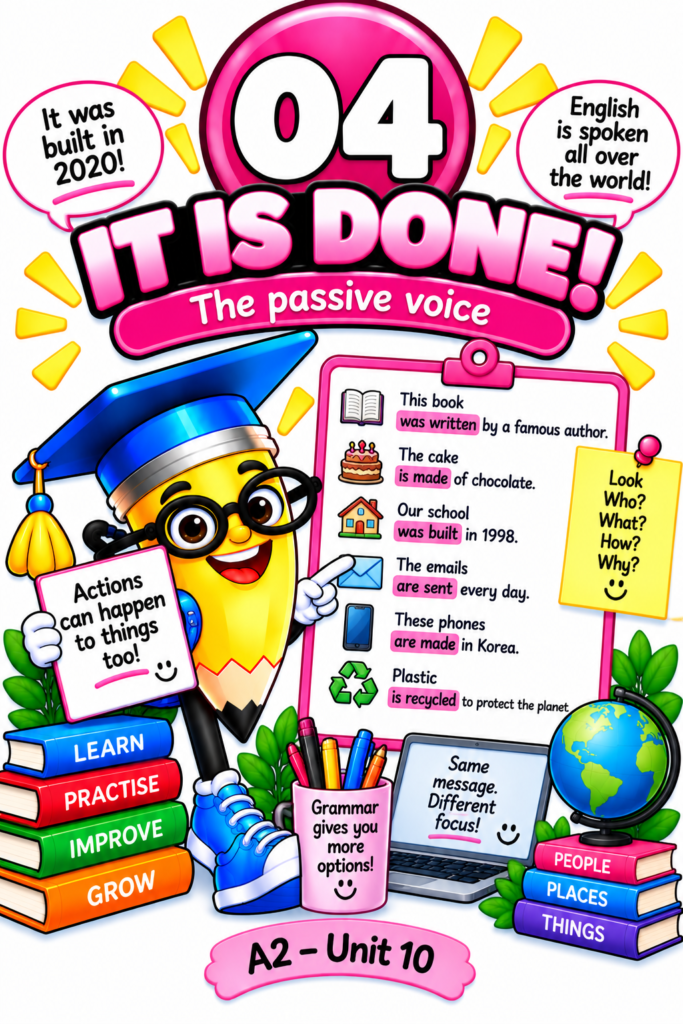
WHAT IS THE PASSIVE VOICE?
We usually use the active voice when we talk about who does something:
People make chocolate in many countries.
In the passive voice, we focus on the thing that receives the action:
Chocolate is made in many countries.
| Active | Passive |
|---|---|
| People make bread. | Bread is made. |
| People grow oranges in Spain. | Oranges are grown in Spain. |
| People make these bags from recycled plastic. | These bags are made from recycled plastic. |
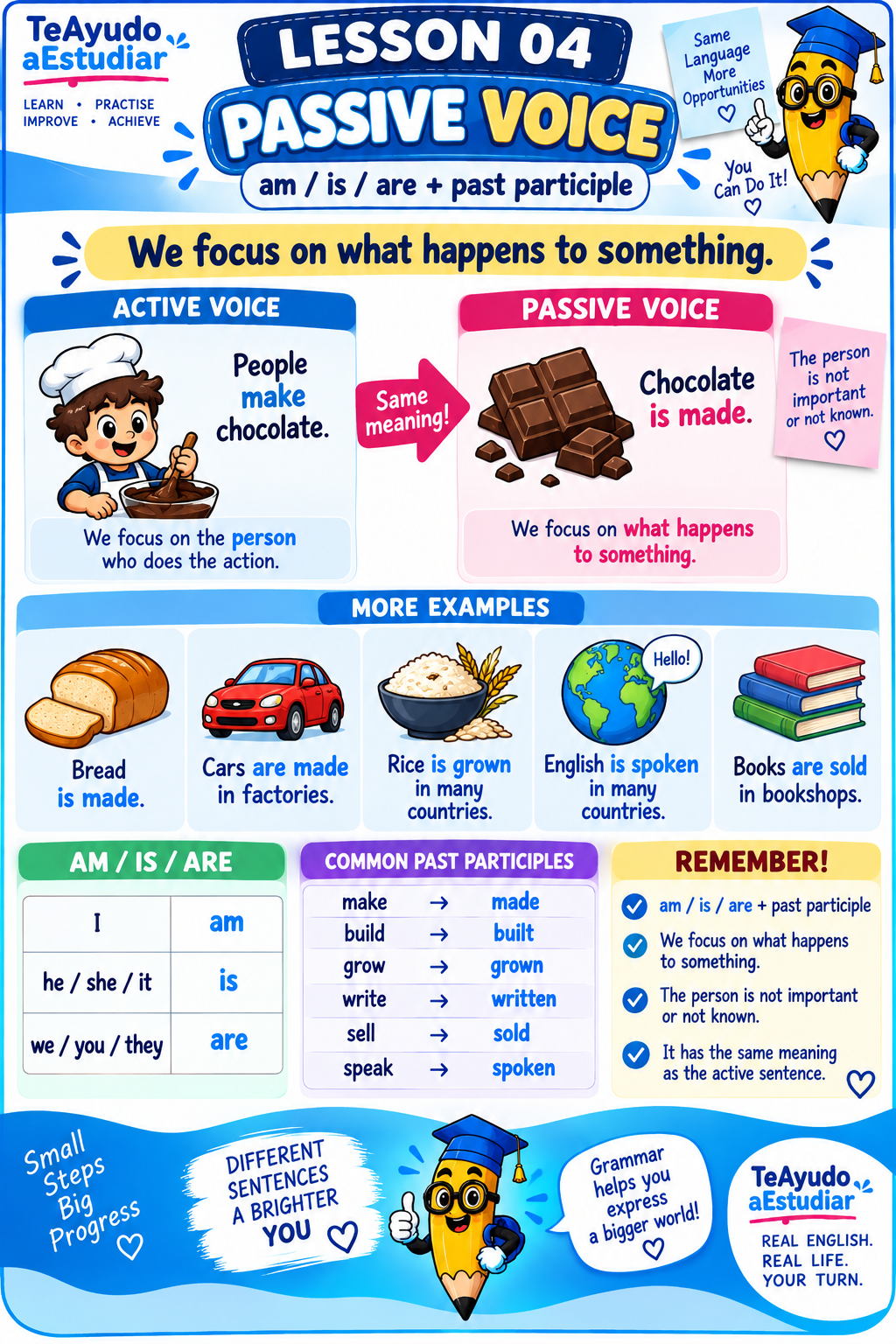
HOW DO WE MAKE IT?
For simple passive sentences in the present, we use:
am / is / are + past participle
| Subject | Be | Example |
|---|---|---|
| I | am | I am invited. |
| he / she / it | is | It is made here. |
| we / you / they | are | They are sold in shops. |
The most important thing is to remember the verb be and the past participle.
COMMON PAST PARTICIPLES
| Verb | Past participle | Example |
|---|---|---|
| make | made | Chocolate is made from cocoa. |
| build | built | Houses are built with different materials. |
| grow | grown | Rice is grown in many countries. |
| write | written | Books are written by authors. |
| sell | sold | These shoes are sold online. |
| make | made | These toys are made in a factory. |
HOW ARE THINGS MADE?
We often use the passive when we talk about products, food, buildings and processes.
- Paper is made from trees.
- Cars are made in factories.
- Olives are grown in many parts of Spain.
- English is spoken in many countries.
- Books are sold in bookshops.
We don’t always need to say who does the action. The important information is often what happens to the thing.
FROM COCOA TO CHOCOLATE
Chocolate is made from cocoa beans. First, cocoa beans are collected from cocoa trees. Then they are cleaned and dried.
After that, the beans are roasted and ground. The cocoa is mixed with other ingredients, such as sugar and milk. Finally, the chocolate is put into moulds.
When the chocolate is ready, it is packed and sent to shops. Chocolate is enjoyed by people all over the world!
🔎 UNDERSTAND THE TEXT
- What is chocolate made from?
- What happens to the cocoa beans first?
- When are the beans roasted?
- What is mixed with the cocoa?
- Where is the chocolate sent?
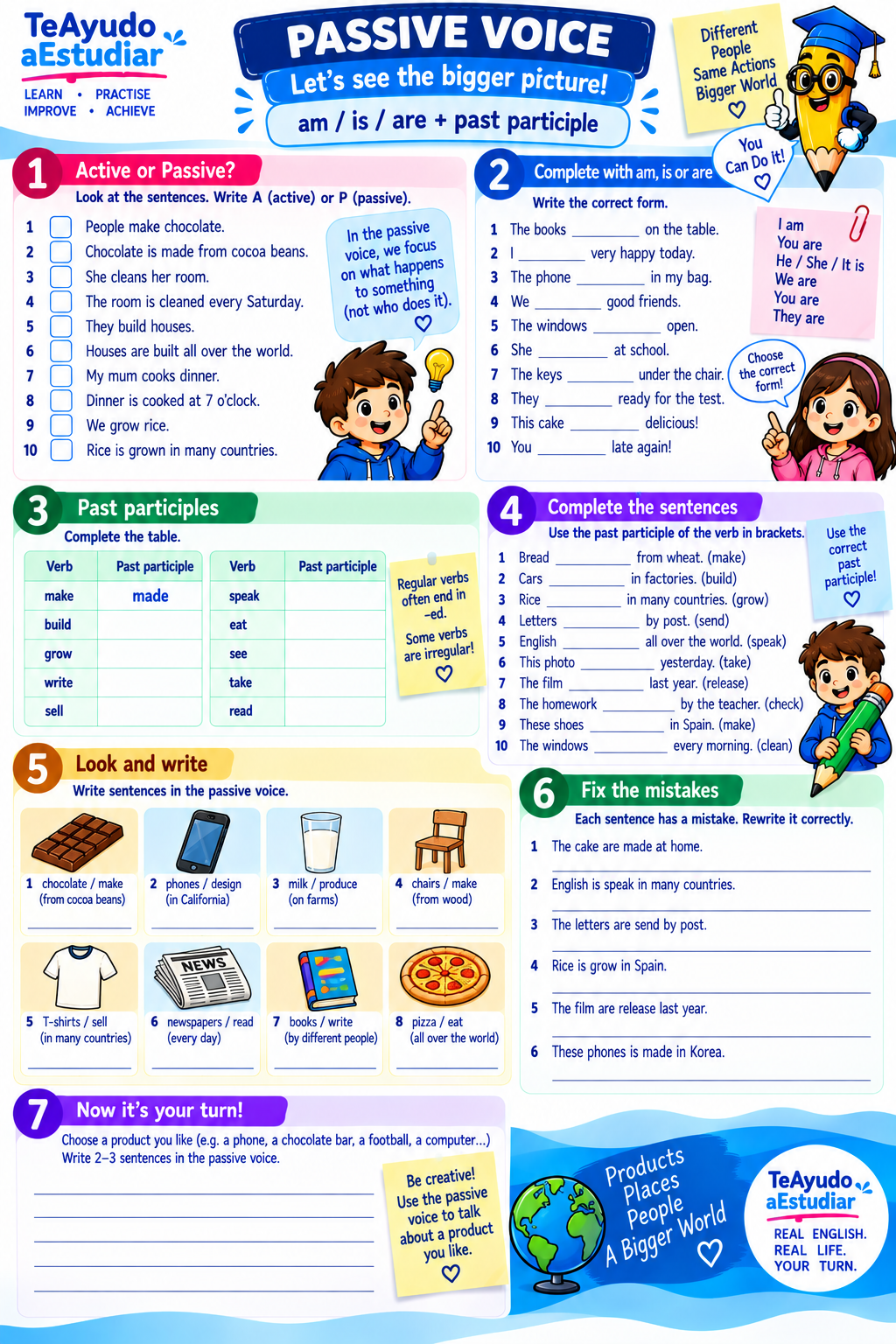
YOUR TURN
Complete the sentences using the passive voice.
- Paper __________ from trees. (make)
- Cars __________ in factories. (make)
- Rice __________ in many countries. (grow)
- Books __________ in bookshops. (sell)
- English __________ in many countries. (speak)
ASK A FRIEND
Choose an everyday object or product and ask your partner:
- What is it?
- What is it made from?
- Where is it made?
- How is it made?
Try to answer with simple passive sentences.
🏆 A2 CHALLENGE
Choose one product: bread, chocolate, a T-shirt, a pencil or another everyday object.
Write four sentences explaining what it is made from and what happens to it. Try to use the passive voice in every sentence.
Example: A pencil is made from wood. It is painted a colour. It is sold in shops.
🎮 GAMES
Practise what you’ve learned! Try these games and practise the passive voice.
¿Qué es la voz pasiva?
La voz pasiva se usa para centrar la atención en la cosa o persona que recibe una acción, en lugar de centrarnos en quién la realiza.
¿Cómo se forma la pasiva en presente?
Usamos am / is / are + past participle: The car is made / The cars are made.
¿Qué es el past participle?
Es la tercera forma del verbo. En verbos regulares suele terminar en -ed, pero algunos verbos son irregulares: make → made, write → written.
¿Tengo que decir quién hace la acción?
No siempre. Muchas veces no es importante o no lo sabemos: Cars are made in factories.
¿Cuál es la diferencia entre “is made” y “are made”?
Usamos is con un sujeto singular y are con un sujeto plural: The car is made / The cars are made.
¿Puedo usar la pasiva para hablar de cosas cotidianas?
Sí. Es muy habitual para hablar de productos, alimentos, edificios y procesos.
¿Tengo que aprender muchos tiempos verbales en pasiva?
No. En esta lección nos centramos en la pasiva simple en presente.
📥 Fichas descargables

📝 Resumen
En esta lección de inglés A2 has aprendido qué es la passive voice y cómo utilizarla para hablar de productos, alimentos y procesos. Has practicado la estructura am / is / are + past participle y has visto cómo podemos centrar la atención en lo que ocurre en lugar de decir quién realiza la acción. Ahora puedes reconocer y formar frases sencillas en voz pasiva en presente.
Recursos Premium Próximamente
Materiales más completos para aprender, practicar y avanzar.
Descubre nuestros cuadernos, packs de fichas y materiales exclusivos, creados para profundizar en cada asignatura y trabajar de forma autónoma.
Cuadernos educativos
Teoría, ejercicios y actividades organizadas para aprender paso a paso
Desde 4.90 €
Packs de fichas
Cientos de fichas listas para imprimir, organizadas por asignaturas y cursos.
Desde 1.99 €
Recursos Premium
Material exclusivo de refuerzo y exámenes con soluciones
Desde 1.99 €
¿Quieres aprender más rápido?
Suscríbete gratis a nuestra newsletter con el código QR o haciendo clic en el botón rojo y recibe recursos educativos, ejercicios, exámenes…
Sin spam. Cancela cuando quieras.

TeAyudoAEstudiar
Plataforma educativa para Primaria, ESO y docentes.
Asignaturas
Matemáticas
Inglés
Lengua
Ciencias Sociales
Recursos
Fichas
Exámenes
Juegos educativos
Recursos Premium
Empresa
Sobre nosotros
Aviso legal
Privacidad
Contacto
© 2026 TeAyudoAEstudiar · Todos los derechos reservados.
Creado por docentes🧡 para ayudarte a aprender.