
LESSON 03: WHAT´S HAPPENING?
Present continuous

Let’s talk about what is happening at home! (present continuous)
🎯 WHAT WILL YOU LEARN?
By the end of this lesson, you will be able to:
- talk about things happening now
- use the Present Continuous
- describe what people are doing at home
- ask and answer questions about what is happening
- use am / is / are + verb-ing
- describe a picture using simple sentences
Ready? Let’s see what’s happening! 😊
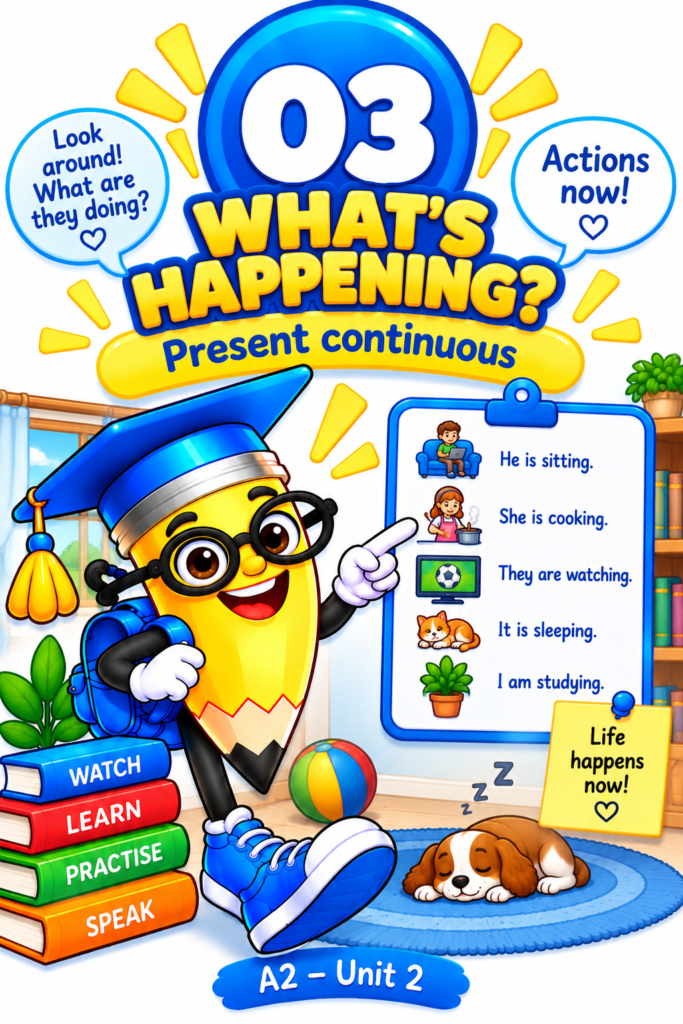
WHAT’S HAPPENING?
Look around you. What are people doing now? Maybe someone is:
reading a book
watching TV
cooking
playing a game
doing homework
When something is happening now, we can use the Present Continuous.
Look!
Emma is reading.
Dad is cooking.
Mum is watching TV.
They are doing these things now.
PRESENT CONTINUOUS
We make the Present Continuous like this:
am / is / are + verb-ing
Look at the examples:
| Person | Verb | Example |
|---|---|---|
| I | am + -ing | I am reading. |
| he / she / it | is + -ing | She is cooking. |
| you / we / they | are + -ing | They are playing. |
💡 Easy trick:
I → am
He / She / It → is
You / We / They → are
✏️ Let’s add -ing!
Many verbs simply add -ing:
play → playing
cook → cooking
read → reading
watch → watching
clean → cleaning
Some verbs change a little:
write → writing
make → making
sit → sitting
run → running
💡 Don’t worry about all the spelling rules now. The most important thing is to recognise and use verb + -ing.
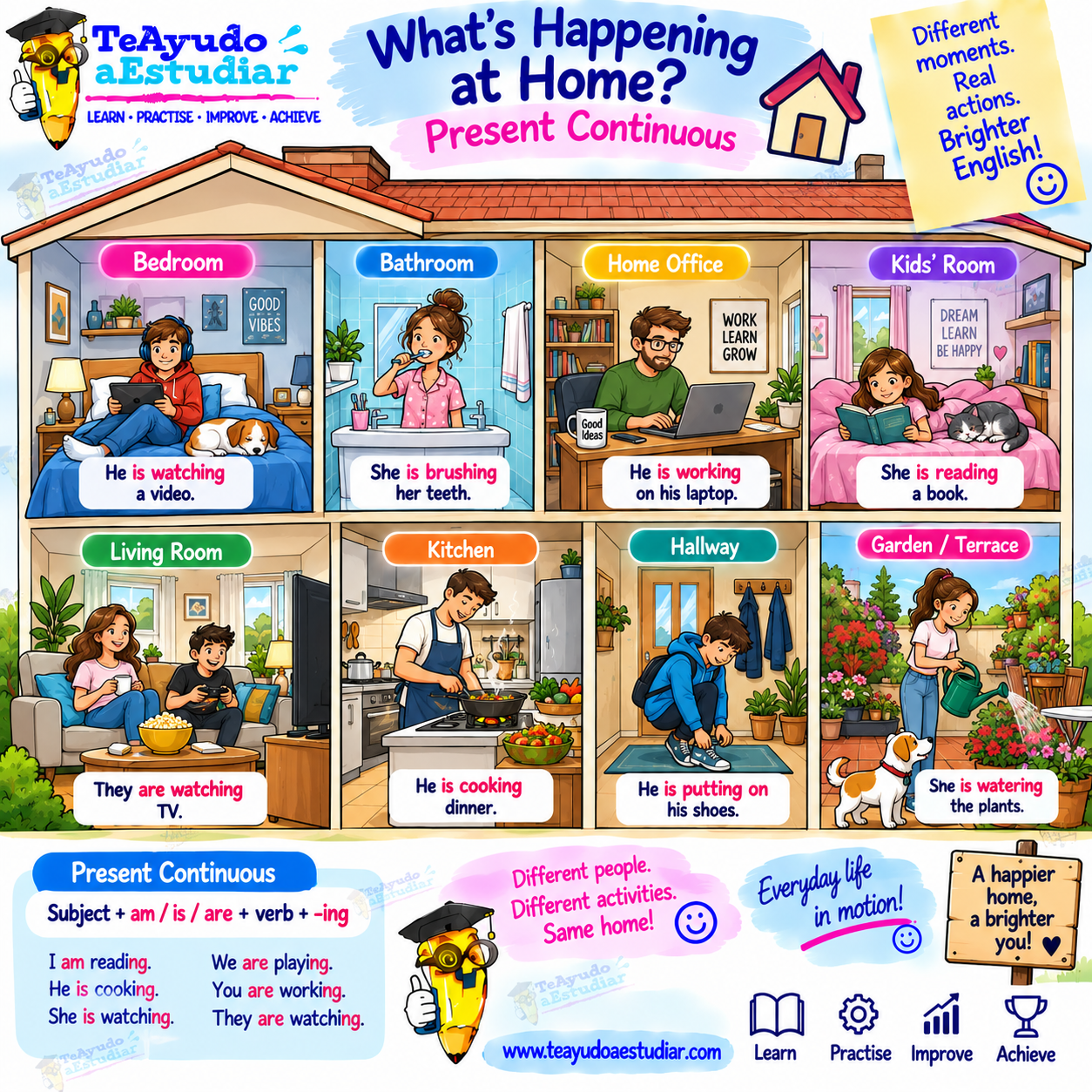
WHAT ARE THEY DOING?
Let’s look at some people at home.
🧑 Alex
Alex is doing his homework.
👩 Mum
Mum is cooking in the kitchen.
👨 Dad
Dad is reading a book.
👧 Emma
Emma is watching TV in the living room.
🐶 The dog
The dog is sleeping.
Notice:
is + verb-ing
WHAT ARE YOU DOING?
We can ask questions about what is happening now.
Ask:
What are you doing?
Answer:
I’m doing my homework.
Or:
I’m watching TV.
We can also ask about other people:
What is Mum doing?
She’s cooking.
What is Dad doing?
He’s reading.
What are the children doing?
They’re playing.
💡 Remember:
What are you doing?
I’m reading.
What is she doing?
She’s cooking.
What are they doing?
They’re playing.
A BUSY AFTERNOON AT HOME
It’s Saturday afternoon and everyone is busy!
The family is at home.
Emma is reading a book in her bedroom.
Her brother Leo is playing a video game in the living room.
Mum is cooking in the kitchen.
Dad is washing the car in the garage.
The dog is sleeping under the table.
🔎 Can you find…?
Who is:
- reading?
- playing a video game?
- cooking?
- washing the car?
- sleeping?
Now answer:
What is Emma doing?
She’s reading a book.
Where is Mum?
She’s in the kitchen.
What is Leo doing?
He’s playing a video game.
Where is the dog?
It’s under the table.
NOT HAPPENING?
We can also say that something isn’t happening now.
We use:
am not / isn’t / aren’t + verb-ing
Examples:
I am not watching TV.
Mum isn’t sleeping.
They aren’t playing outside.
💡 Look!
- She is cooking.
- She isn’t sleeping.
The first sentence says what is happening.
The second says what is not happening.
WHAT’S HAPPENING IN YOUR HOME?
Now it’s your turn!
Think about your home right now.
Complete the sentences:
I am __________.
My __________ is __________.
My __________ is __________ in the __________.
Someone in my home is __________.
Someone in my home isn’t __________.
You can use:
cooking · eating · reading · watching TV · studying · playing · sleeping · cleaning · listening to music · doing homework
💡 Remember:
When you talk about something happening now, use:
am / is / are + verb-ing
🎮 Juegos «present continuous»
Practise what you’ve learned!
Try these games and practise the Present Continuous and actions happening now.
1. ¿Cuándo usamos el Present Continuous?
Lo usamos principalmente para hablar de algo que está ocurriendo ahora.
I am reading now.
2. ¿Cómo formo el Present Continuous?
Utilizamos:
am / is / are + verbo-ing
Por ejemplo:
She is cooking.
3. ¿Qué usamos con I?
Con I usamos am:
I am reading.
4. ¿Qué usamos con he, she e it?
Usamos is:
He is sleeping.
She is cooking.
It is raining.
5. ¿Qué usamos con you, we y they?
Usamos are:
You are reading.
We are studying.
They are playing.
6. ¿Cómo pregunto qué está haciendo alguien?
Puedes preguntar:
What is he doing?
What is she doing?
Por ejemplo:
What is she doing?
She’s watching TV.
7. ¿Cómo digo que algo no está pasando?
Utilizamos:
isn’t / aren’t + verb-ing
Por ejemplo:
He isn’t sleeping.
They aren’t playing.
8. ¿Todos los verbos forman el -ing de la misma manera?
No siempre. Algunos verbos cambian un poco su escritura:
write → writing
make → making
sit → sitting
Pero lo más importante en este nivel es recordar la estructura:
am / is / are + verb-ing
Fichas descargables
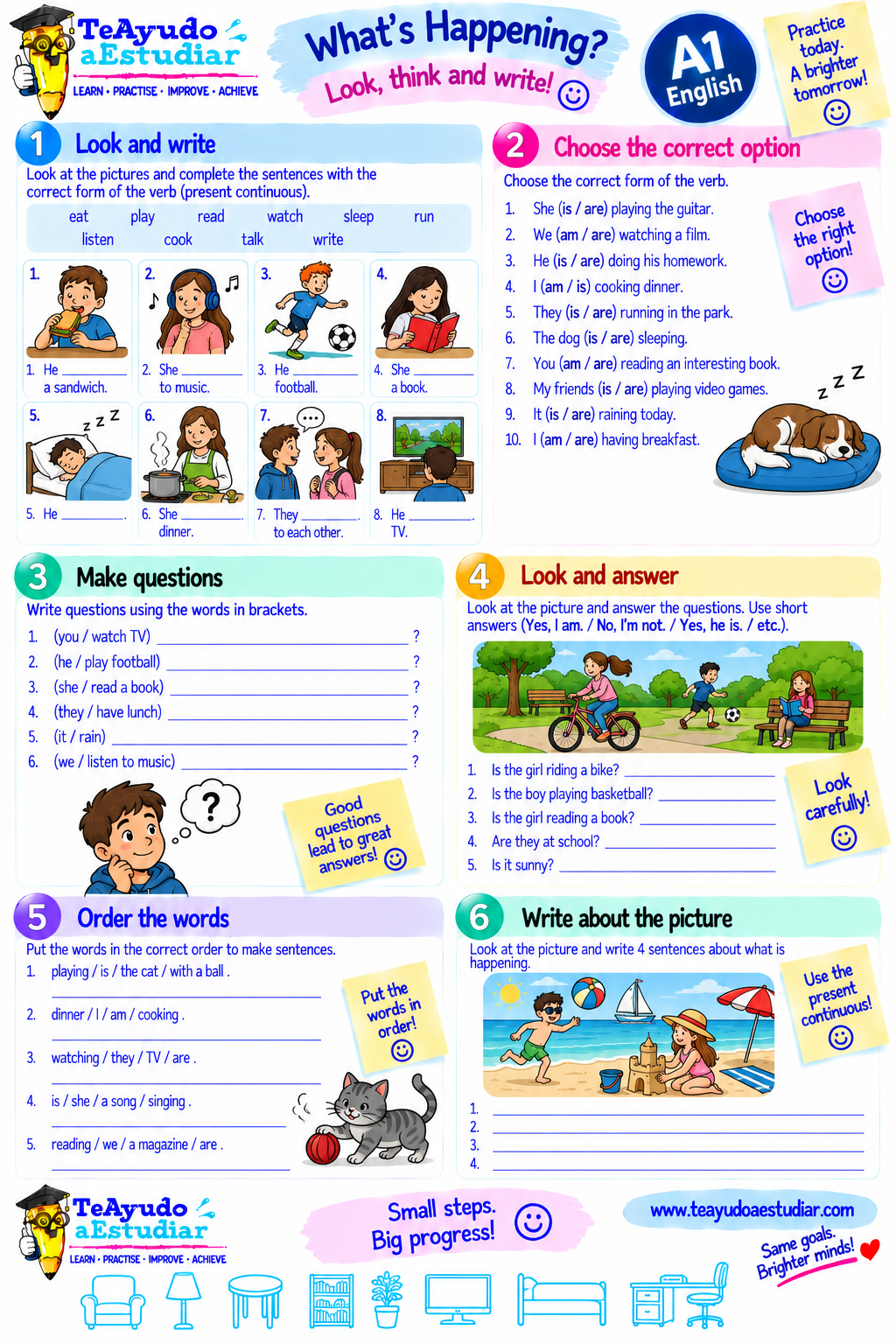

📝 Resumen
En esta lección de inglés A2 aprenderás a utilizar el Present Continuous para hablar de acciones que están ocurriendo en este momento. Practicarás la estructura am / is / are + verbo-ing, aprenderás a describir qué están haciendo diferentes personas en casa y podrás formular preguntas como What are you doing? o What is she doing?. También practicarás las formas negativas y utilizarás el Present Continuous para describir situaciones y fotografías.
Recursos Premium Próximamente
Materiales más completos para aprender, practicar y avanzar.
Descubre nuestros cuadernos, packs de fichas y materiales exclusivos, creados para profundizar en cada asignatura y trabajar de forma autónoma.
Cuadernos educativos
Teoría, ejercicios y actividades organizadas para aprender paso a paso
Desde 4.90 €
Packs de fichas
Cientos de fichas listas para imprimir, organizadas por asignaturas y cursos.
Desde 1.99 €
Recursos Premium
Material exclusivo de refuerzo y exámenes con soluciones
Desde 1.99 €
¿Quieres aprender más rápido?
Suscríbete gratis a nuestra newsletter con el código QR o haciendo clic en el botón rojo y recibe recursos educativos, ejercicios, exámenes…
Sin spam. Cancela cuando quieras.

TeAyudoAEstudiar
Plataforma educativa para Primaria, ESO y docentes.
Asignaturas
Matemáticas
Inglés
Lengua
Ciencias Sociales
Recursos
Fichas
Exámenes
Juegos educativos
Recursos Premium
Empresa
Sobre nosotros
Aviso legal
Privacidad
Contacto
© 2026 TeAyudoAEstudiar · Todos los derechos reservados.
Creado por docentes🧡 para ayudarte a aprender.