
LESSON 05: MY DAY

Let’s talk about your daily routine!
🎯 WHAT WILL YOU LEARN?
By the end of this lesson, you will be able to:
- talk about your daily routine
- describe what you do every day
- use the Present Simple to talk about routines
- use common verbs for daily activities
- say when you do things during the day
- ask and answer questions about daily routines
Ready? Let’s talk about your day! 😊
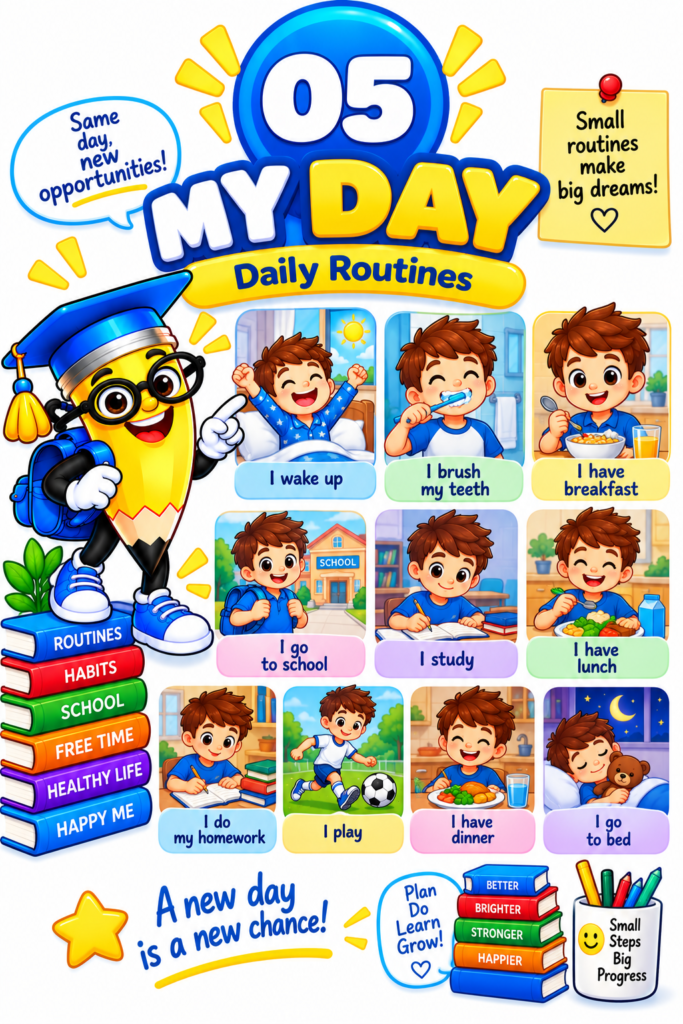
MY DAILY ROUTINE
We all do different things every day. We get up, have breakfast, go to school, have lunch and go to bed.
Let’s learn some useful expressions to talk about your day!
| English | Spanish |
|---|---|
| get up | levantarse |
| have breakfast | desayunar |
| get dressed | vestirse |
| brush my teeth | lavarme los dientes |
| go to school | ir al colegio |
| have classes | tener clases |
| have lunch | almorzar |
| go home | ir a casa |
| do my homework | hacer los deberes |
| play with my friends | jugar con mis amigos |
| have dinner | cenar |
| go to bed | acostarse |

🕐 My day
Look at these examples:
I get up at seven o’clock.
I have breakfast at half past seven.
I go to school at eight o’clock.
I have lunch at two o’clock.
I do my homework in the afternoon.
I go to bed at ten o’clock.
💡 Remember: We use at + time.
at 7 o’clock · at half past eight · at 9:30
✏️ I DO IT EVERY DAY!
We use the Present Simple to talk about things we do regularly or every day.
👦 I / You / We / They
Use the verb in its basic form:
| Subject | Example |
|---|---|
| I | I get up early. |
| You | You go to school. |
| We | We have lunch at two. |
| They | They play football. |
👧 He / She / It
With he, she and it, we usually add -s to the verb.
| Subject | Example |
|---|---|
| He | He gets up early. |
| She | She goes to school. |
| It | It starts at nine. |
💡 Easy trick:
He / She / It → verb + S
I play football. → She plays football.
I get up at seven. → He gets up at seven.
WHAT DO YOU DO EVERY DAY?
To ask about someone’s routine, we use Do or Does.
🙋 Asking about routines
What do you do in the morning?
I have breakfast and go to school.
What time do you get up?
I get up at seven o’clock.
What does he do after school?
He does his homework.
What time does she go to bed?
She goes to bed at ten o’clock.
💡 DO or DOES?
| Subject | Question |
|---|---|
| I / you / we / they | Do you get up early? |
| he / she / it | Does he get up early? |
Remember:
Does she play tennis? ✅
Does she plays tennis? ❌
After does, the main verb goes back to its basic form.
A DAY IN MY LIFE
Now let’s put everything together!
👦 Meet Alex
Hi! I’m Alex. I get up at seven o’clock every morning. I have breakfast with my family and then I get dressed. I go to school at eight o’clock. I have lunch at two and go home in the afternoon. I do my homework after school. Then I play with my friends. I have dinner at nine o’clock and I go to bed at ten.
🔎 Can you find…?
Find these activities in Alex’s day:
- get up
- have breakfast
- go to school
- have lunch
- do homework
- play with friends
- have dinner
- go to bed
✍️ Now it’s your turn!
Complete the sentences about your day:
I get up at __________.
I have breakfast at __________.
I go to school at __________.
I have lunch at __________.
I __________ after school.
I have dinner at __________.
I go to bed at __________.
💡 Remember: You learned how to tell the time in Lesson 04. Now use it to talk about your daily routine!
Try these games and practise daily routines, Present Simple and everyday activities.
🎮 Juegos «my day»
Practise what you’ve learned!
Try these games and practise daily routines, Present Simple and everyday activities.
1. ¿Cuándo usamos el Present Simple?
Lo usamos para hablar de rutinas, hábitos y cosas que hacemos normalmente.
2. ¿Por qué decimos She plays pero I play?
Con he, she e it, normalmente añadimos -s al verbo.
3. ¿Decimos She play o She plays?
Decimos She plays. Recuerda: he/she/it + verb + s.
4. ¿Cómo pregunto a alguien qué hace cada día?
Puedes preguntar: What do you do every day?
5. ¿Cómo pregunto a qué hora hace algo?
Usamos What time… ?
What time do you get up?
6. ¿Usamos do o does?
Usamos do con I, you, we, they y does con he, she, it.
7. ¿Decimos Does she goes to school??
No. Después de does, usamos el verbo en su forma básica:
Does she go to school? ✅
8. ¿Cómo digo la hora a la que hago algo?
Usamos at + time:
I get up at seven o’clock.
Fichas descargables «my day»

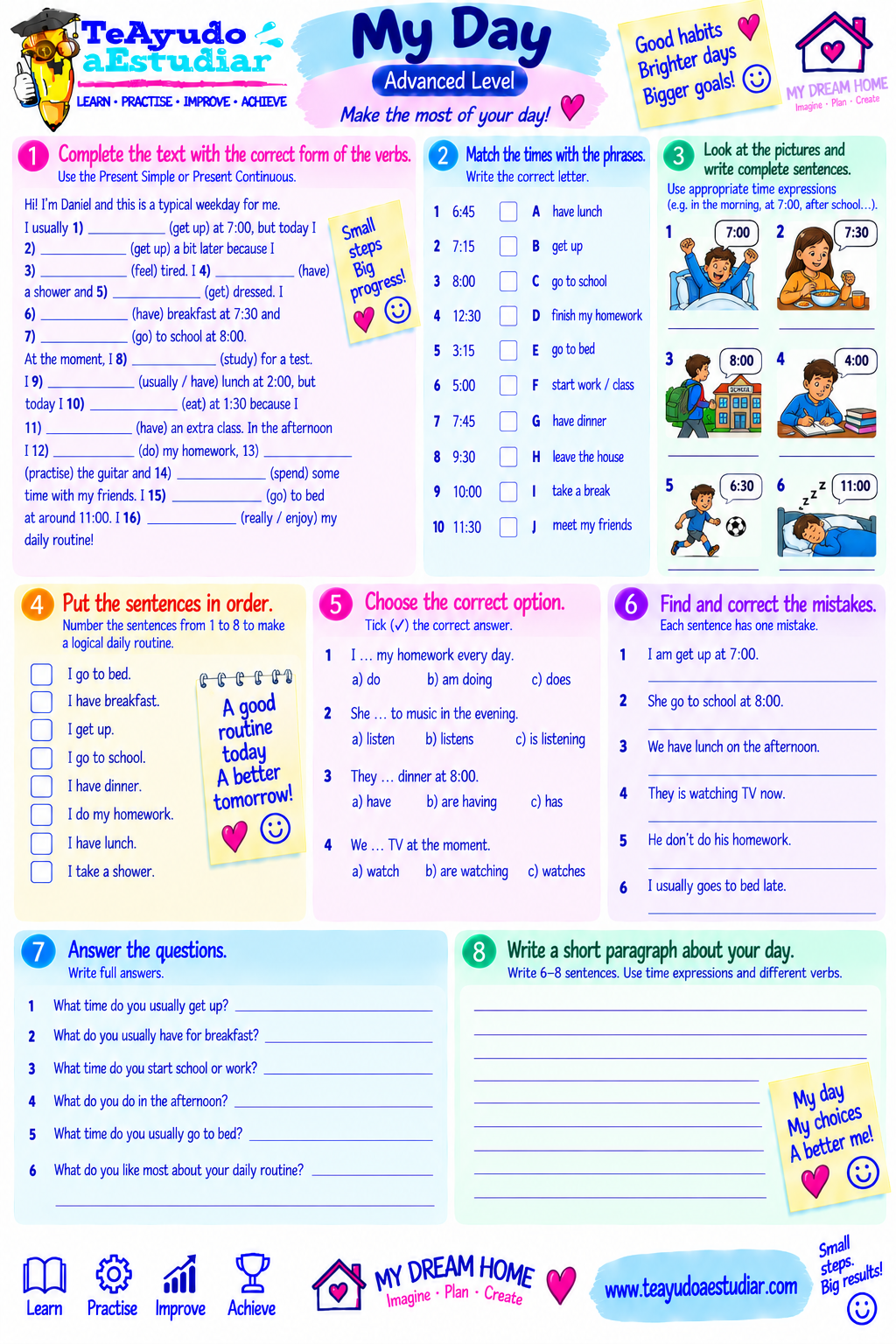
📝 Resumen
En esta lección de inglés A2 aprenderás a hablar sobre tu rutina diaria utilizando expresiones como get up, have breakfast, go to school o go to bed. También practicarás el Present Simple para describir hábitos y rutinas, aprenderás cuándo utilizar do y does en preguntas y recordarás cómo expresar la hora con at + time. Al final podrás describir en inglés lo que haces durante un día normal.
Recursos Premium Próximamente
Materiales más completos para aprender, practicar y avanzar.
Descubre nuestros cuadernos, packs de fichas y materiales exclusivos, creados para profundizar en cada asignatura y trabajar de forma autónoma.
Cuadernos educativos
Teoría, ejercicios y actividades organizadas para aprender paso a paso
Desde 4.90 €
Packs de fichas
Cientos de fichas listas para imprimir, organizadas por asignaturas y cursos.
Desde 1.99 €
Recursos Premium
Material exclusivo de refuerzo y exámenes con soluciones
Desde 1.99 €
¿Quieres aprender más rápido?
Suscríbete gratis a nuestra newsletter con el código QR o haciendo clic en el botón rojo y recibe recursos educativos, ejercicios, exámenes…
Sin spam. Cancela cuando quieras.

TeAyudoAEstudiar
Plataforma educativa para Primaria, ESO y docentes.
Asignaturas
Matemáticas
Inglés
Lengua
Ciencias Sociales
Recursos
Fichas
Exámenes
Juegos educativos
Recursos Premium
Empresa
Sobre nosotros
Aviso legal
Privacidad
Contacto
© 2026 TeAyudoAEstudiar · Todos los derechos reservados.
Creado por docentes🧡 para ayudarte a aprender.