
LESSON 03: GET WELL SOON!

Let’s talk about getting better! 💚
🎯 WHAT WILL YOU LEARN?
By the end of this lesson, you will be able to:
- give simple advice about common health problems
- use should to say what is a good idea
- use shouldn’t to say what is not a good idea
- ask for simple advice when you don’t feel well
- understand and give advice about everyday health problems
- use health vocabulary from the previous lesson in complete sentences
Ready? Let’s help someone feel better! 😊
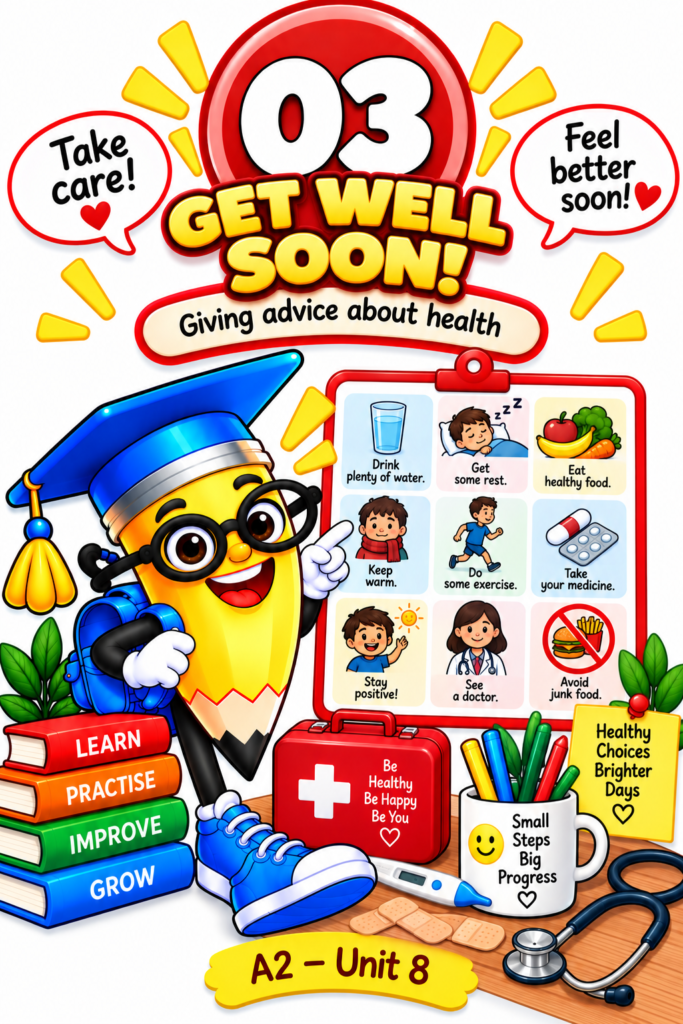
💚 HOW CAN YOU FEEL BETTER?
When someone has a health problem, we can give simple advice. We often use should and shouldn’t.
Should = a good idea
Use should + verb when you think something is a good idea.
You should rest.
You should drink some water.
You should go to bed.
Shouldn’t = not a good idea
Use shouldn’t + verb when you think something is not a good idea.
You shouldn’t play football today.
You shouldn’t stay up late.
You shouldn’t eat too much.
💡 Remember: After should and shouldn’t, use the verb in its basic form.
✅ You should rest.
❌ You should to rest.
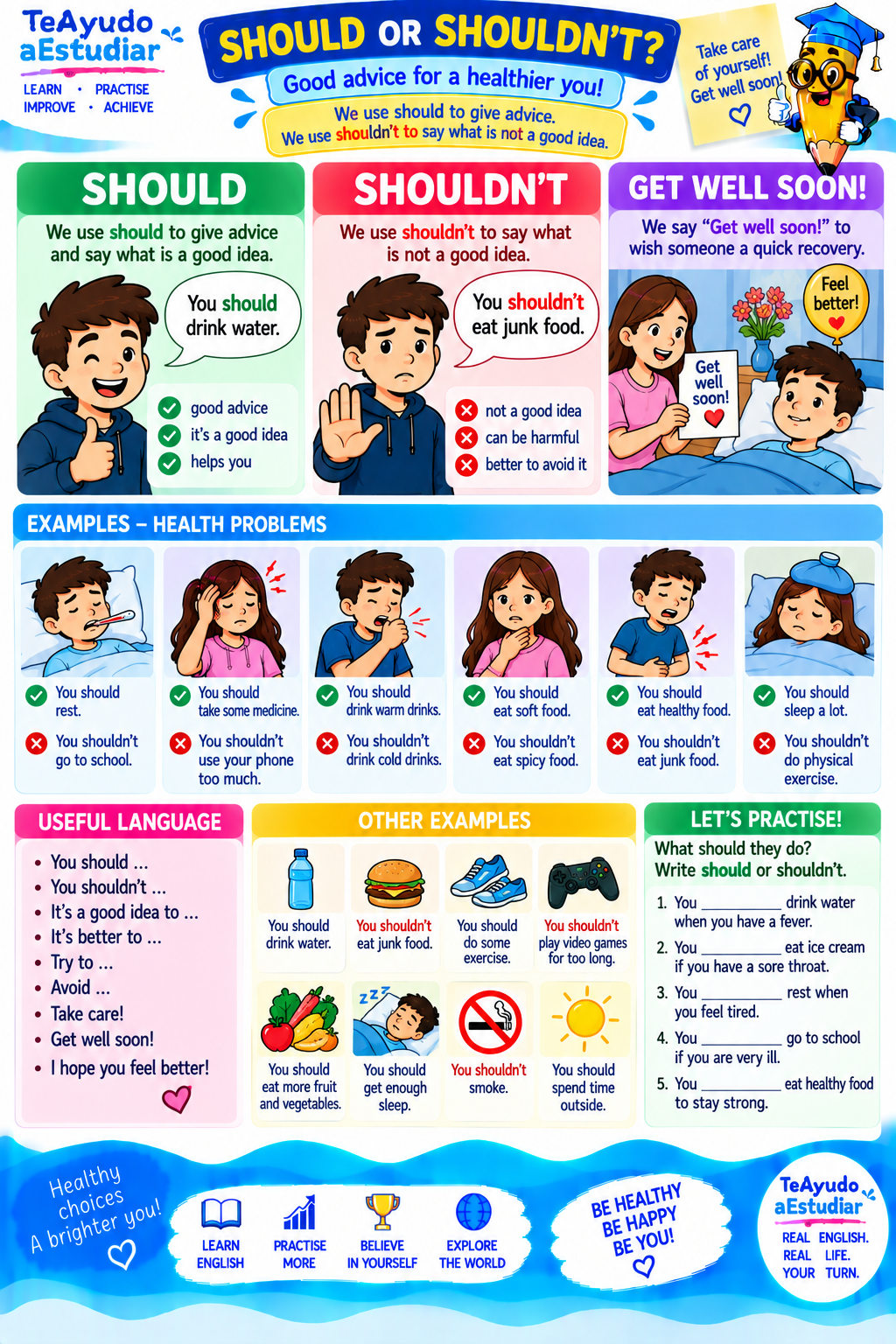
🤒 HEALTH PROBLEM → GOOD ADVICE
| Problem | Advice |
|---|---|
| I’ve got a headache. | You should rest. |
| I’ve got a cough. | You should drink some water. |
| I’ve got a sore throat. | You should have a warm drink. |
| I’ve got a cold. | You should stay at home and rest. |
| I’ve got a stomachache. | You shouldn’t eat too much. |
| I’ve got a toothache. | You should see a dentist. |
❓ WHAT SHOULD I DO?
We can ask for advice with a simple question:
I’ve got a headache. What should I do?
I’ve got a cough. What should I do?
We can answer with You should… or You shouldn’t….
A: I’ve got a headache. What should I do?
B: You should rest.
🗣️ A CHAT WITH A FRIEND
Sofia: Hi, Max. You don’t look well.
Max: I don’t feel well. I’ve got a bad headache.
Sofia: What should you do?
Max: I don’t know.
Sofia: You should rest and drink some water. You shouldn’t use your phone for a long time.
Max: Good idea. Thanks!
Check your understanding
- How does Max feel?
- What’s the matter with him?
- What should Max do?
- What shouldn’t he do?
🔎 SHOULD OR SHOULDN’T?
Choose the best advice for each situation.
- I’ve got a headache. → You should rest.
- I’ve got a temperature. → You should tell an adult.
- I’ve got a sore throat. → You should drink some water.
- I’ve got a stomachache. → You shouldn’t eat too much.
- I’ve got a cold. → You should rest.
✏️ GIVE SOME ADVICE
Imagine that a friend has one of these problems. Write one piece of advice.
- a headache → You should…
- a cough → You should…
- a toothache → You should…
- a stomachache → You shouldn’t…
- a sore throat → You should…
🏆 A2 CHALLENGE
Read each problem and give two pieces of advice. Try to use both should and shouldn’t.
I’ve got a bad cold.
You should rest.
You shouldn’t go outside in the cold.
🎮 GAMES — Practise health advice!
Practise should, shouldn’t and health vocabulary with these games!
¿Qué significa should?
Should significa que algo es una buena idea o que es recomendable hacer algo.
¿Qué significa shouldn’t?
Shouldn’t indica que algo no es una buena idea o que es recomendable no hacerlo.
¿Qué verbo usamos después de should?
Usamos el verbo en su forma básica: You should rest. No decimos You should to rest.
¿Cambia should con he o she?
No. Siempre usamos should: I should rest / He should rest / She should rest.
¿Cómo pregunto qué debería hacer?
Puedes preguntar What should I do?.
¿Puedo decir You should to drink water?
No. Después de should no usamos to: You should drink water.
¿Should siempre significa que algo es obligatorio?
No. Should normalmente expresa consejo o recomendación, no una obligación.
¿Ya tengo que aprender todas las expresiones de salud?
No. Lo importante es poder reconocer los problemas de salud más habituales y usarlos en frases sencillas.
📥 Fichas descargables

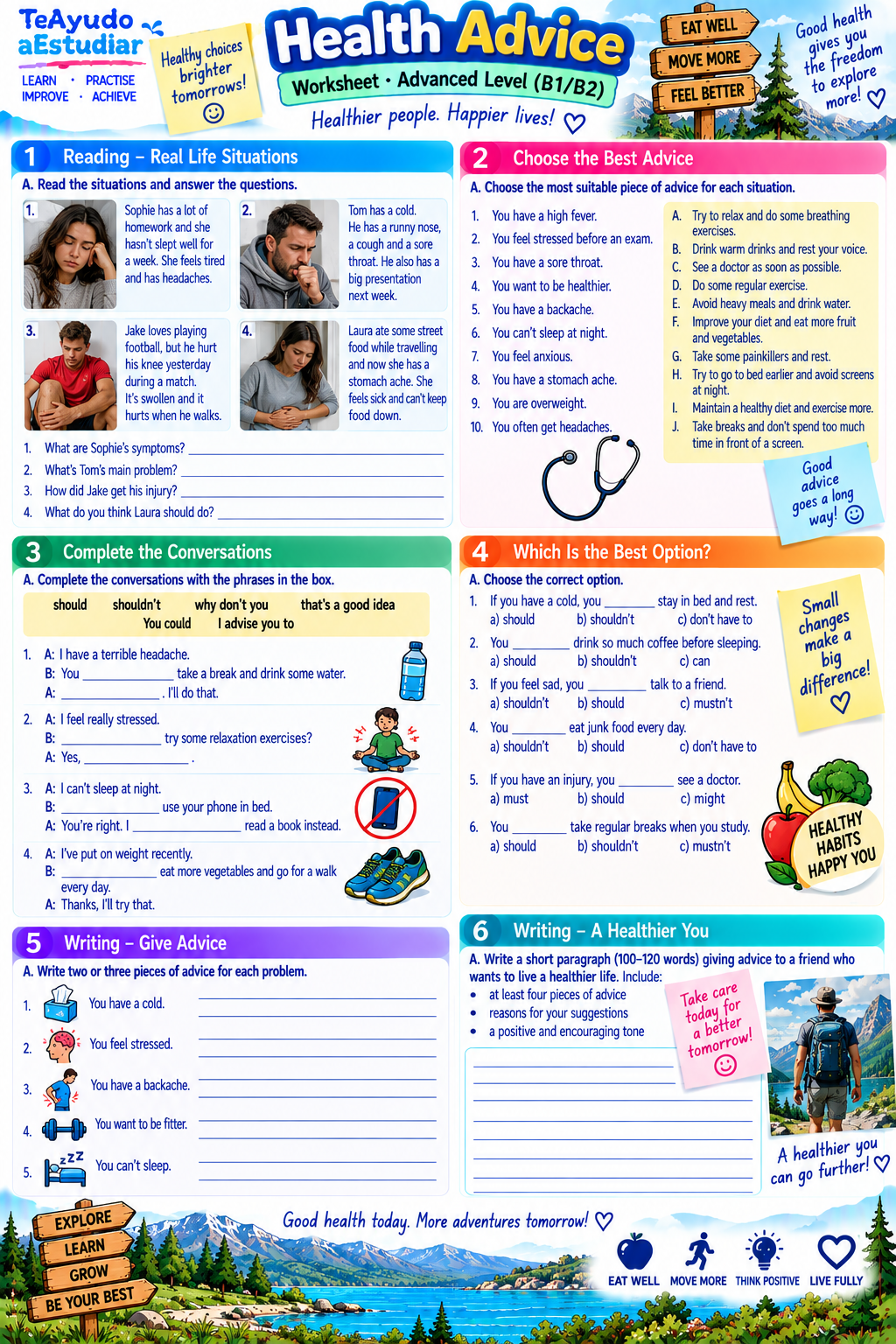
📝 Resumen
En esta lección de inglés A2 aprendemos a dar consejos sobre problemas de salud utilizando should y shouldn’t. Practicamos cómo decir qué es recomendable hacer, qué no es una buena idea y cómo preguntar What should I do?. También reutilizamos el vocabulario de salud de la lección anterior en pequeñas conversaciones y situaciones cotidianas.
Recursos Premium Próximamente
Materiales más completos para aprender, practicar y avanzar.
Descubre nuestros cuadernos, packs de fichas y materiales exclusivos, creados para profundizar en cada asignatura y trabajar de forma autónoma.
Cuadernos educativos
Teoría, ejercicios y actividades organizadas para aprender paso a paso
Desde 4.90 €
Packs de fichas
Cientos de fichas listas para imprimir, organizadas por asignaturas y cursos.
Desde 1.99 €
Recursos Premium
Material exclusivo de refuerzo y exámenes con soluciones
Desde 1.99 €
¿Quieres aprender más rápido?
Suscríbete gratis a nuestra newsletter con el código QR o haciendo clic en el botón rojo y recibe recursos educativos, ejercicios, exámenes…
Sin spam. Cancela cuando quieras.

TeAyudoAEstudiar
Plataforma educativa para Primaria, ESO y docentes.
Asignaturas
Matemáticas
Inglés
Lengua
Ciencias Sociales
Recursos
Fichas
Exámenes
Juegos educativos
Recursos Premium
Empresa
Sobre nosotros
Aviso legal
Privacidad
Contacto
© 2026 TeAyudoAEstudiar · Todos los derechos reservados.
Creado por docentes🧡 para ayudarte a aprender.