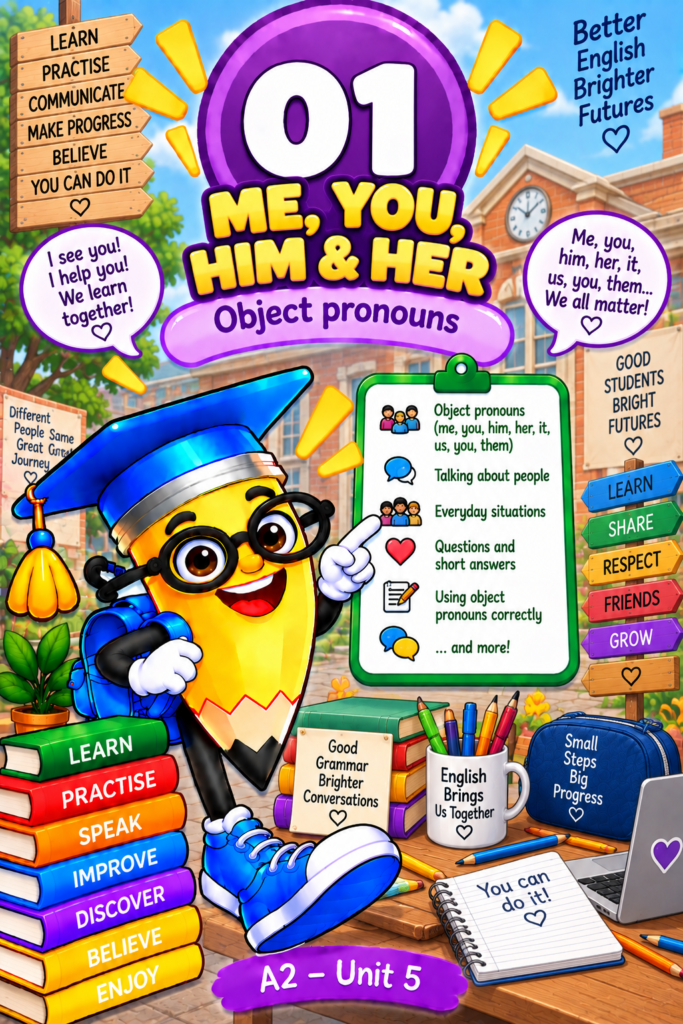
LESSON 01: OBJECT PRONOUNS

Let’s talk about object pronouns?
🎯 WHAT WILL YOU LEARN?
In this lesson, you will learn to:
- understand the difference between subject and object pronouns.
- use me, you, him, her, it, us and them.
- use object pronouns after common verbs.
- talk about people and things you like, help, know or see.
- ask and answer simple questions using object pronouns.
- use object pronouns in everyday school situations.
Ready? Let’s meet the object pronouns! 😊
WHO ARE WE TALKING ABOUT?
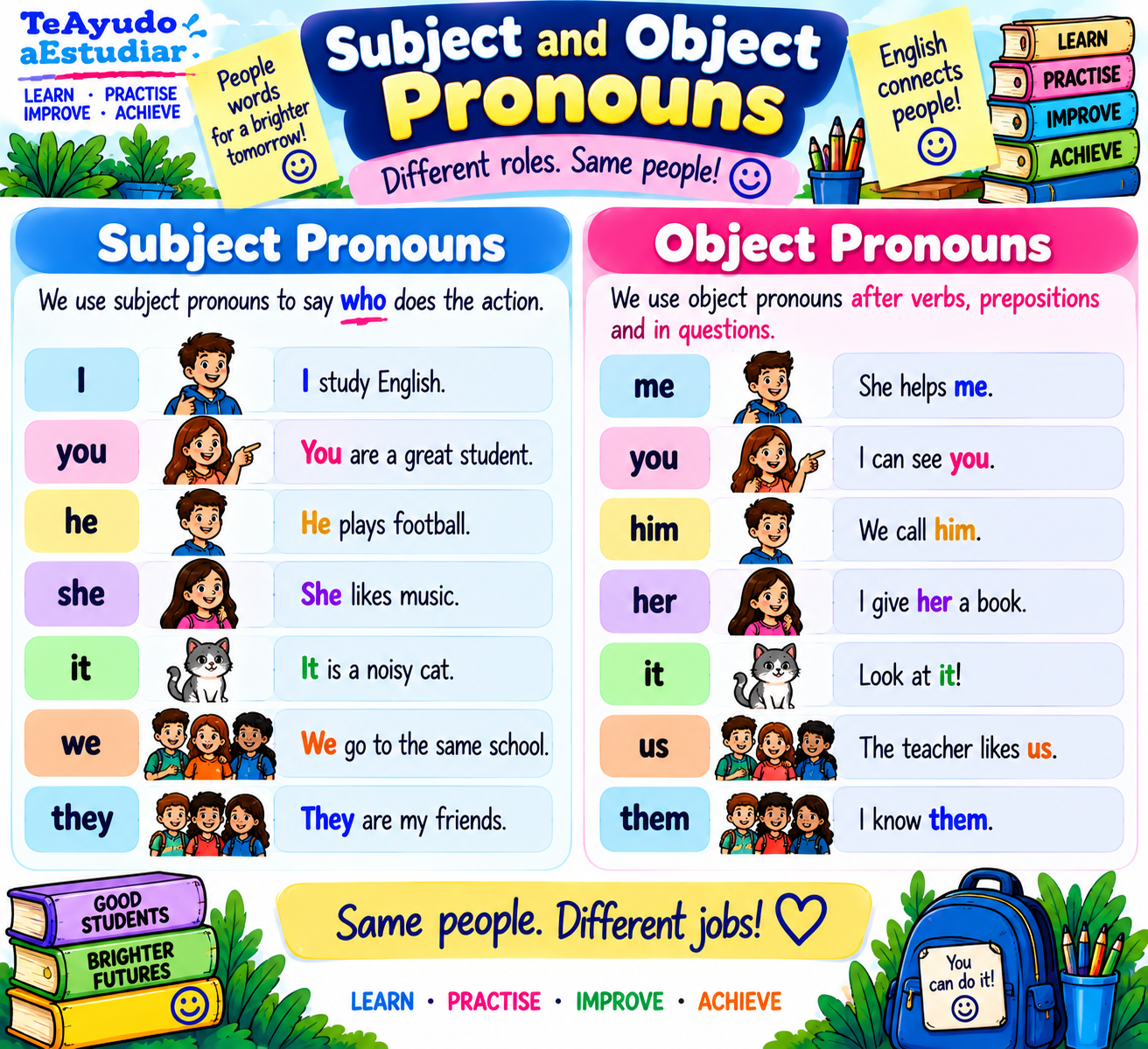
You already know these subject pronouns:
| 👤 Subject | 🇪🇸 Español |
|---|---|
| I | yo |
| you | tú / vosotros/as |
| he | él |
| she | ella |
| it | ello / eso |
| we | nosotros/as |
| they | ellos/as |
We use them when the person or thing does the action.
I like English.
She plays tennis.
They study together.
But sometimes a person or thing receives the action.
That’s when we use an object pronoun.
ME, YOU, HIM, HER, IT, US, THEM
Here are the object pronouns you need to know:
| 👤 Subject | 🎯 Object | 🇪🇸 Español |
|---|---|---|
| I | me | me |
| you | you | te / os |
| he | him | lo / le |
| she | her | la / le |
| it | it | lo / la |
| we | us | nos |
| they | them | los / las / les |
⭐ Look at the difference
- I like Anna. → I am doing the action.
- I like her. → Anna receives the action.
Another example: They help us.
- They = the people doing the action.
- us = the people receiving the action.
OBJECT PRONOUNS IN ACTION
Object pronouns often come after a verb.
❤️ LIKE
- I like him.
- She likes me.
- We like them.
👋 SEE
- I see her at school.
- He sees us every day.
🤝 HELP
- They help me with my homework.
- I help him with English.
🧠 KNOW
- I know her.
- Do you know them?
⭐ Easy trick
When you see a verb, ask:
Who receives the action?
Emma helps Jack.
Who does the action? → Emma
Who receives the action? → Jack
So:
Emma helps him.
🏫 AT SCHOOL
Object pronouns are very useful when we talk about school.
My teacher helps me.
I help my friend.
→ I help him.
We know our English teacher.
→ We know her.
My friends like our teacher.
→ They like her.
The teacher gives us homework.
→ The teacher gives us homework.
🧩 Let’s replace the names
- I see Maria every day. → I see her every day.
- Tom helps Jack. → Tom helps him.
- We know Sarah and Emma. → We know them.
- My friends help me. → My friends help me.
- The teacher helps Tom and me. → The teacher helps us.
👀 LOOK AT THE PICTURE!
Imagine a classroom with four students:
👦 Ben
👧 Lucy
👦 Sam
👧 Emma
Now look at these sentences:
Ben helps Lucy. → Ben helps her.
Lucy helps Sam. → Lucy helps him.
Sam helps Ben and Emma. → Sam helps them.
Emma helps me. → Emma helps me.
🎯 Your turn!
Replace the person or people with an object pronoun.
- I know Tom. → I know ______.
- She helps Anna. → She helps ______.
- We like Ben and Jack. → We like ______.
- They help me. → They help ______.
- I see Lucy every morning. → I see ______.
✅ Answers
- him
- her
- them
- me
- her
❤️ WHO DO YOU LIKE?
We can use questions with Who…? to talk about people.
- Who do you like?
- I like Emma. I like her.
- Who does Tom help?
- He helps Jack. He helps him.
- Who do they know?
- They know Sarah and Lucy. They know them.
💬 Ask a friend!
- Who do you like at school?
- Who helps you with your homework?
- Who do you sit next to?
- Who do you know in your class?
You can answer with names first and then use an object pronoun:
- I like Maria. I like her.
📚 A FRIENDLY CLASS
Read about Leo and his classmates.
Hi! I’m Leo. I really like my class. My best friend is Max. I see him every morning at school.
Our English teacher is Mrs Green. She is very nice and she helps us with English. We like her a lot.
I also have two good friends, Emma and Mia. I sit next to them in class. They are very funny and they always help me with my homework.
I like my classmates because we help each other. School is much more fun when you have good friends!
🔎 Let’s check!
- Who is Leo’s best friend?
- Who does Leo see every morning?
- Who helps Leo and his classmates with English?
- Who does Leo sit next to?
- Who helps Leo with his homework?
- Does Leo like his classmates?
- Find an example of him in the text.
- Find an example of her, us, them and me.
🧠 SUBJECT OR OBJECT?
Let’s compare them one more time.
| 👤 Subject | 🎯 Object | Example |
|---|---|---|
| I | me | She helps me. |
| you | you | I know you. |
| he | him | I like him. |
| she | her | We see her. |
| it | it | I like it. |
| we | us | They help us. |
| they | them | I know them. |
⭐ Remember!
- I → me
- he → him
- she → her
- we → us
- they → them
And:
- you → you
- it → it
These two don’t change.
✏️ TALK ABOUT YOUR CLASS
Now think about your own school life.
Complete the sentences:
- I like __________. I like him/her.
- __________ helps me with __________.
- I know __________. I know him/her/them.
- I see __________ at school.
- __________ helps us with __________.
¿Qué es un object pronoun?
Es un pronombre de objeto. Lo utilizamos para referirnos a la persona o cosa que recibe la acción.
I help Maria.
I help her.
¿Cuál es la diferencia entre I y me?
I realiza la acción:
I help Tom.
Me recibe la acción:
Tom helps me.
¿Cuál es la diferencia entre he y him?
He realiza la acción:
He helps me.
Him recibe la acción:
I help him.
¿Cuál es la diferencia entre she y her?
She realiza la acción:
She helps me.
Her recibe la acción:
I help her.
¿Cuál es la diferencia entre they y them?
They realiza la acción:
They help us.
Them recibe la acción:
We help them.
¿You cambia cuando es object pronoun?
No. You es igual:
- You help me.
- I help you.
¿It cambia?
No. It también es igual:
- I like it.
- It helps me.
¿Dónde colocamos normalmente los object pronouns?
Normalmente van después del verbo:
- I like him.
- She helps me.
- We know them.
🎮 GAMES — OBJECT PRONOUNS
Practise the object pronouns from this lesson!
Try these games and practise rooms in my home
Fichas descargables

📝 Resumen
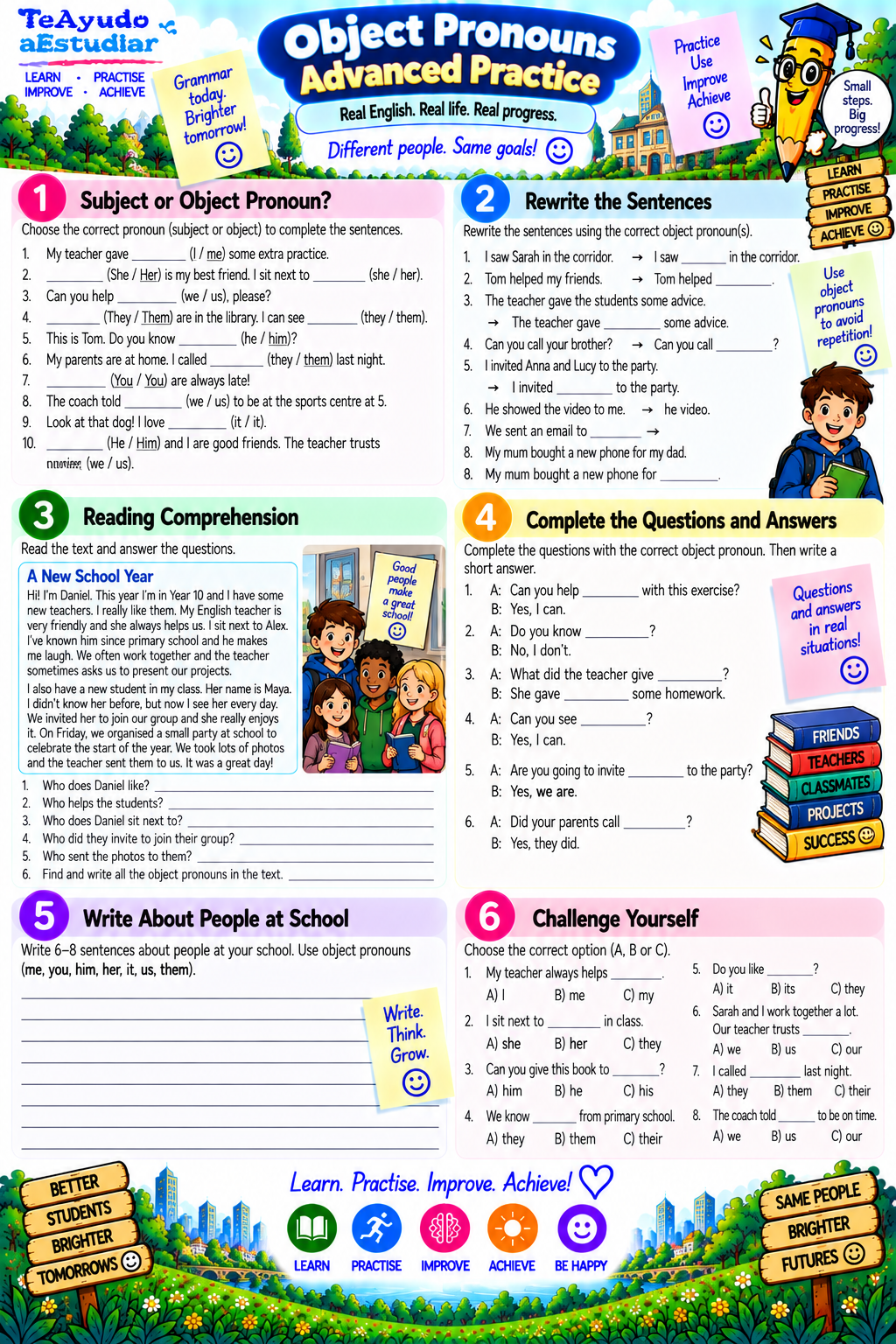
En esta lección de inglés A2 aprenderás a utilizar los object pronouns para hablar de las personas y cosas que reciben una acción. Aprenderás las formas me, you, him, her, it, us y them, y las compararás con los pronombres personales de sujeto como I, he, she, we y they. Practicarás estas formas en situaciones relacionadas con el colegio utilizando verbos frecuentes como like, see, help y know, y terminarás hablando sobre las personas de tu clase.
Recursos Premium Próximamente
Materiales más completos para aprender, practicar y avanzar.
Descubre nuestros cuadernos, packs de fichas y materiales exclusivos, creados para profundizar en cada asignatura y trabajar de forma autónoma.
Cuadernos educativos
Teoría, ejercicios y actividades organizadas para aprender paso a paso
Desde 4.90 €
Packs de fichas
Cientos de fichas listas para imprimir, organizadas por asignaturas y cursos.
Desde 1.99 €
Recursos Premium
Material exclusivo de refuerzo y exámenes con soluciones
Desde 1.99 €
¿Quieres aprender más rápido?
Suscríbete gratis a nuestra newsletter con el código QR o haciendo clic en el botón rojo y recibe recursos educativos, ejercicios, exámenes…
Sin spam. Cancela cuando quieras.

TeAyudoAEstudiar
Plataforma educativa para Primaria, ESO y docentes.
Asignaturas
Matemáticas
Inglés
Lengua
Ciencias Sociales
Recursos
Fichas
Exámenes
Juegos educativos
Recursos Premium
Empresa
Sobre nosotros
Aviso legal
Privacidad
Contacto
© 2026 TeAyudoAEstudiar · Todos los derechos reservados.
Creado por docentes🧡 para ayudarte a aprender.