
LESSON 03: WHAT IS IT?

Let’s talk about things and what they are like! 🔎
🎯 WHAT WILL YOU LEARN?
By the end of this lesson, you will be able to:
- describe everyday things with simple adjectives
- ask and answer What is it? and What is it like?
- talk about what things are used for
- use simple words to describe objects and places
- give short descriptions of familiar things
- understand simple descriptions of everyday objects
Ready? Let’s become detectives! 🔎😊
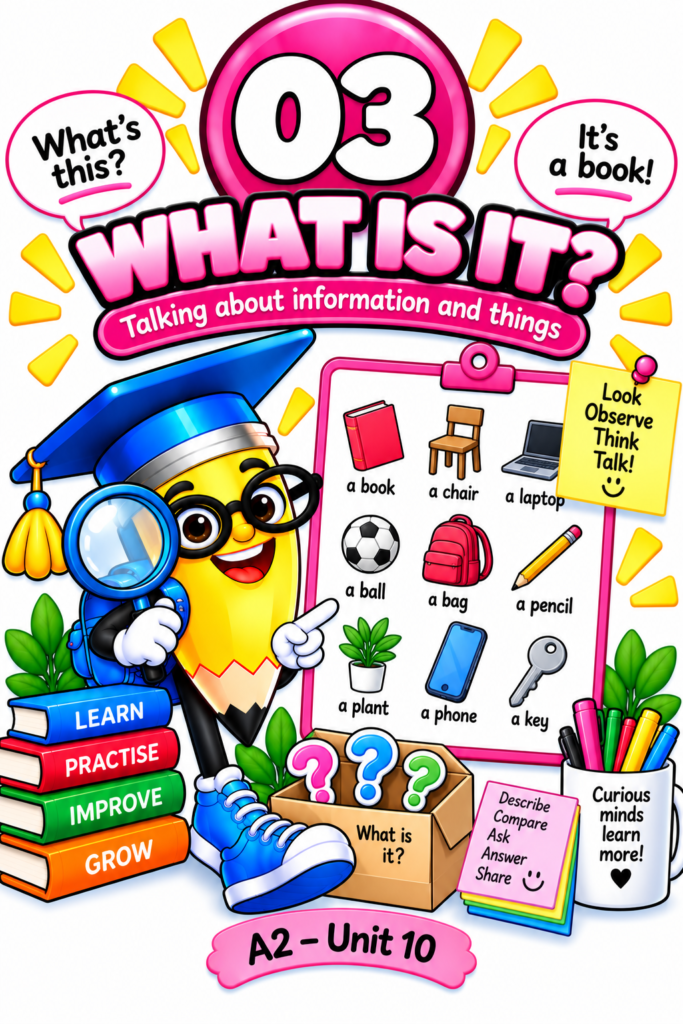
🔎 WHAT IS IT?
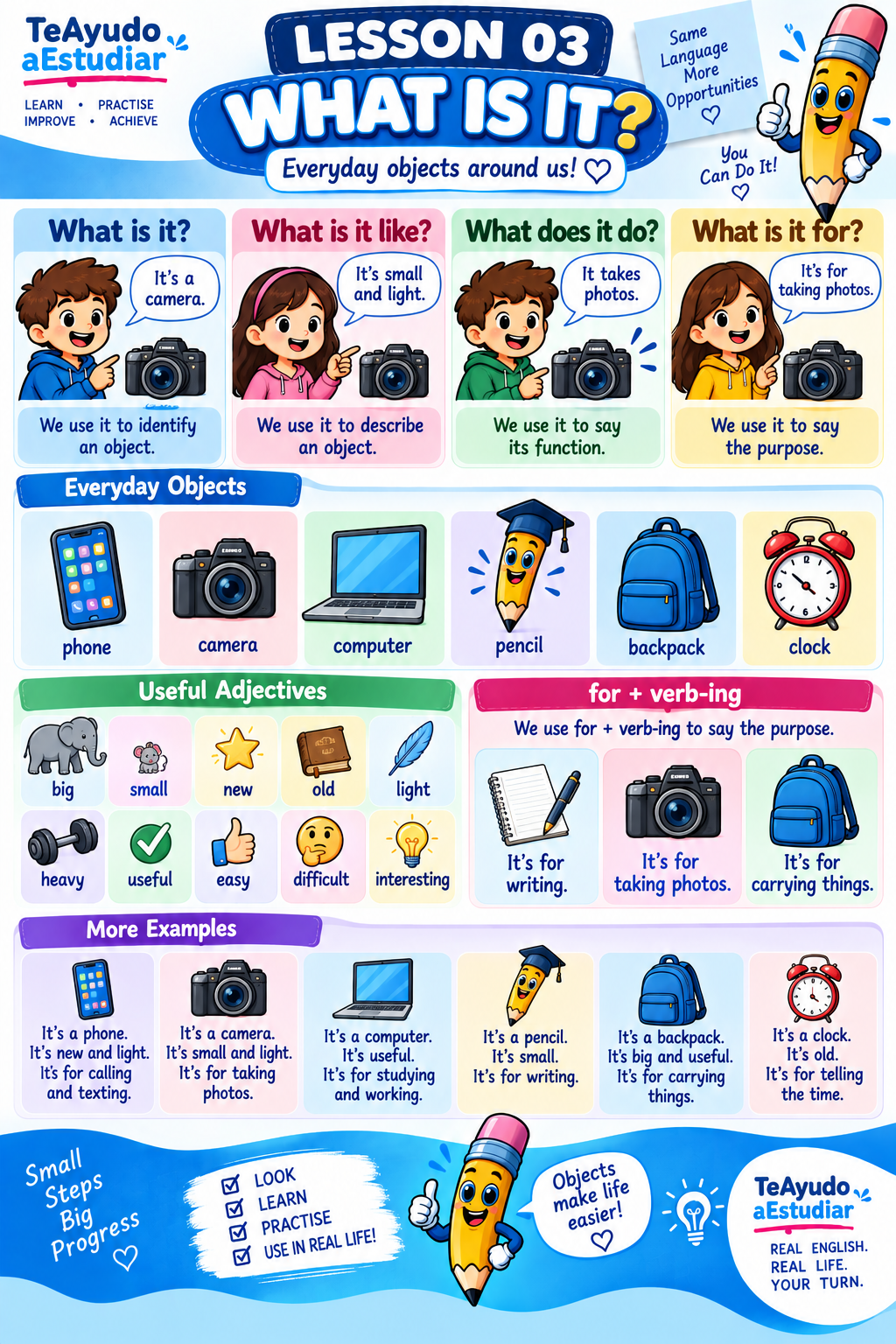
Sometimes we want to identify something. We can ask:
What is it? → It’s a camera.
We can also ask about its characteristics:
What is it like? → It’s small, light and useful.
| Question | What we want to know | Example |
|---|---|---|
| What is it? | what something is | It’s a tablet. |
| What is it like? | what something is like | It’s small and light. |
| What does it do? | what something does | It takes photos. |
| What is it for? | what we use it for | It’s for taking photos. |
🎨 DESCRIBING THINGS
We can use simple adjectives to describe objects.
| Adjective | Example |
|---|---|
| big | It’s a big box. |
| small | It’s a small phone. |
| new | It’s a new computer. |
| old | It’s an old camera. |
| light | It’s light and easy to carry. |
| heavy | It’s quite heavy. |
| useful | It’s very useful. |
| easy | It’s easy to use. |
| difficult | It’s difficult to use. |
| interesting | It’s very interesting. |
🧰 WHAT DOES IT DO?
We can describe an object by saying what it does.
| Thing | What does it do? |
|---|---|
| a phone | It makes calls and sends messages. |
| a camera | It takes photos. |
| a computer | It helps us work and study. |
| a fridge | It keeps food cold. |
| a washing machine | It washes clothes. |
| a clock | It tells us the time. |
🎯 WHAT IS IT FOR?
We can also talk about the purpose of something.
- A camera is for taking photos.
- A dictionary is for finding words.
- A pencil is for writing.
- A backpack is for carrying things.
After for, we can use a verb ending in -ing: for writing, for carrying, for taking.
📖 THE MYSTERY OBJECT
Emma has a mystery object in her school bag. Her friends have to guess what it is.
“What is it like?” asks Leo.
“It’s small and light,” says Emma. “It’s black and rectangular.”
“What does it do?” asks Mia.
“It helps me study. I can use it to find information and write things.”
“Is it your phone?” asks Leo.
“No, it isn’t.”
“Is it a dictionary?” asks Mia.
“No!” says Emma. “You can use it to look up words, but it has a screen.”
“I know!” says Leo. “It’s a tablet!”
“Exactly!” says Emma.
🔎 UNDERSTAND THE STORY
- Where is Emma’s mystery object?
- What does it look like?
- What can Emma use it for?
- Is it her phone?
- What is the mystery object?
✏️ DESCRIBE AN OBJECT
Choose an object in your room or school bag. Don’t say its name. Write four or five clues.
- What is it like?
- What colour is it?
- What does it do?
- What is it for?
Can a friend guess your object?
🗣️ ASK A FRIEND
Choose an object and ask your partner questions until you can guess it.
- What is it?
- What is it like?
- What does it do?
- What is it for?
- Is it big or small?
🏆 A2 CHALLENGE
Write a short description of a useful object. Include:
- three adjectives
- what it does
- what it is for
Don’t write the name of the object. Can someone guess what it is?
🎮 GAMES
Practise what you’ve learned! Try these games and practise describing things.
¿Qué significa “What is it?”?
Significa “¿Qué es?”. La usamos para identificar algo: What is it? — It’s a camera.
¿Qué diferencia hay entre “What is it?” y “What is it like?”?
What is it? pregunta qué es una cosa. What is it like? pregunta cómo es.
¿Cómo pregunto para qué sirve algo?
Puedes usar What is it for?: What is it for? — It’s for writing.
¿Por qué usamos -ing después de “for” en estos ejemplos?
Cuando hablamos de la finalidad de un objeto, usamos expresiones como for writing, for taking photos o for carrying things.
¿Cómo digo que algo es pequeño y ligero?
Puedes decir It’s small and light.
¿Puedo describir un objeto con varios adjetivos?
Sí. Por ejemplo: It’s small, black and useful.
¿Tengo que aprender todos los adjetivos de la tabla?
No. Aprende los más útiles y practica usándolos para describir objetos que conoces.
📥 Fichas descargables
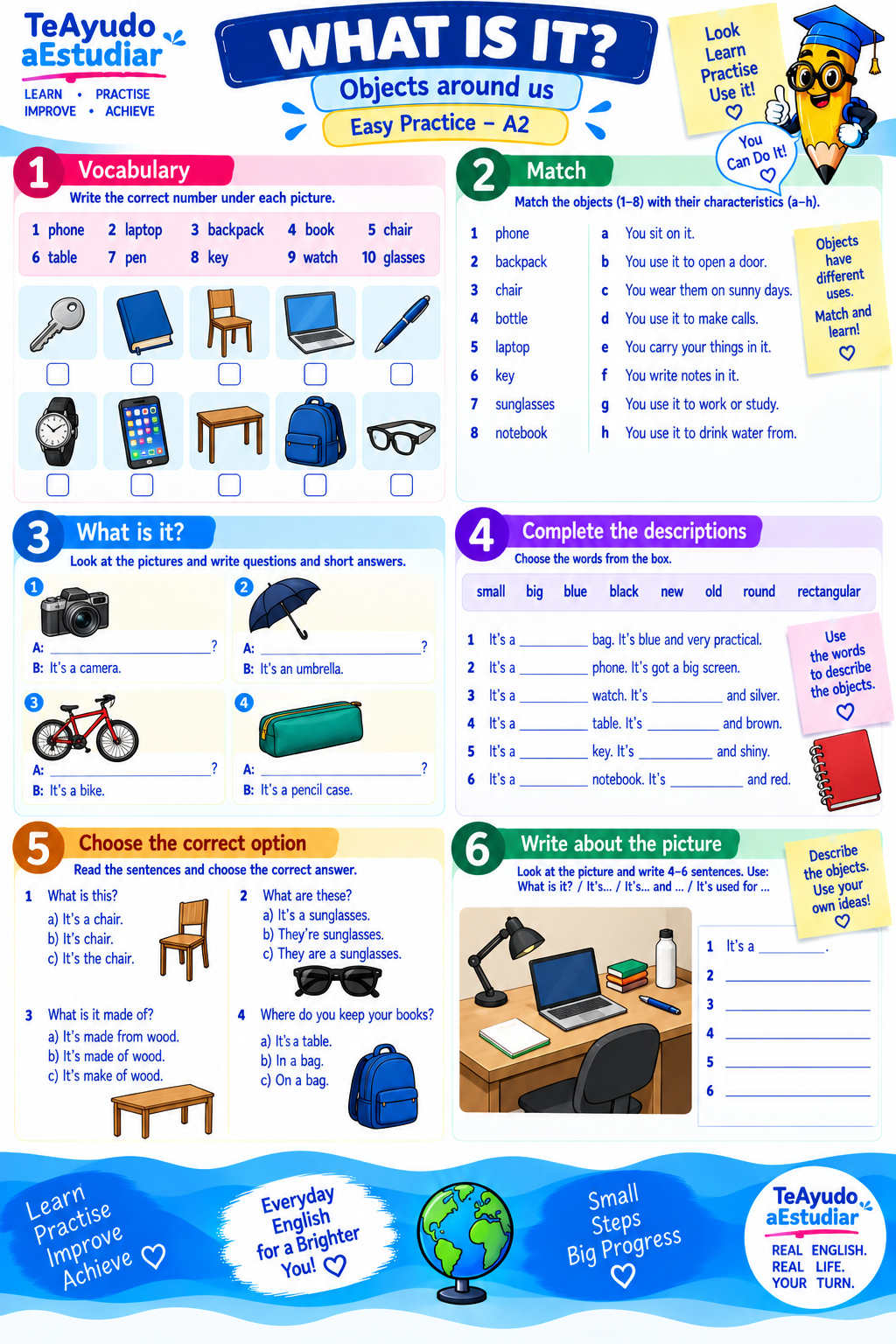

📝 Resumen
En esta lección de inglés A2 has aprendido a identificar y describir objetos cotidianos. Has practicado preguntas como What is it?, What is it like?, What does it do? y What is it for?, además de adjetivos para explicar cómo son las cosas y expresiones para hablar de su función. Ahora puedes describir objetos sencillos y dar pistas para que otra persona adivine de qué objeto estás hablando.
Recursos Premium Próximamente
Materiales más completos para aprender, practicar y avanzar.
Descubre nuestros cuadernos, packs de fichas y materiales exclusivos, creados para profundizar en cada asignatura y trabajar de forma autónoma.
Cuadernos educativos
Teoría, ejercicios y actividades organizadas para aprender paso a paso
Desde 4.90 €
Packs de fichas
Cientos de fichas listas para imprimir, organizadas por asignaturas y cursos.
Desde 1.99 €
Recursos Premium
Material exclusivo de refuerzo y exámenes con soluciones
Desde 1.99 €
¿Quieres aprender más rápido?
Suscríbete gratis a nuestra newsletter con el código QR o haciendo clic en el botón rojo y recibe recursos educativos, ejercicios, exámenes…
Sin spam. Cancela cuando quieras.

TeAyudoAEstudiar
Plataforma educativa para Primaria, ESO y docentes.
Asignaturas
Matemáticas
Inglés
Lengua
Ciencias Sociales
Recursos
Fichas
Exámenes
Juegos educativos
Recursos Premium
Empresa
Sobre nosotros
Aviso legal
Privacidad
Contacto
© 2026 TeAyudoAEstudiar · Todos los derechos reservados.
Creado por docentes🧡 para ayudarte a aprender.