LESSON 05: TALKING ABOUT THE PAST

Let’s talk about the past! ⏰
🎯 WHAT WILL YOU LEARN?
By the end of this lesson, you will be able to:
- talk about things that happened in the past
- use the Past Simple in affirmative sentences
- use common regular and irregular past verbs
- use time expressions such as yesterday and last week
- ask simple questions about the past
- make negative sentences about past events
Ready? Let’s travel back in time! ⏳
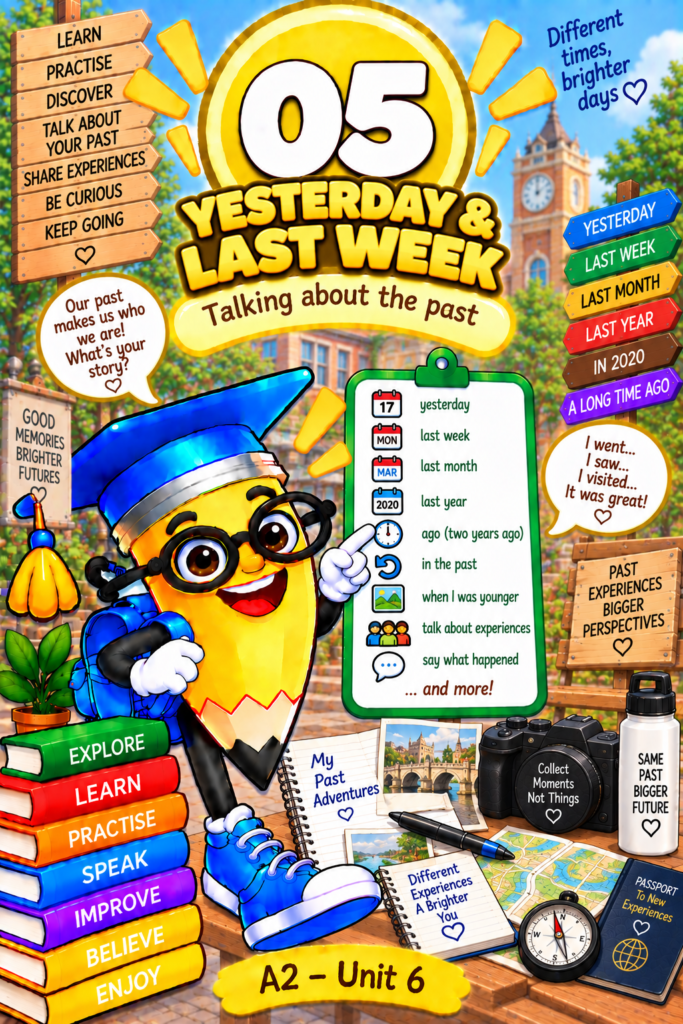
⏰ WHEN DID IT HAPPEN?
We use the Past Simple to talk about actions and events that happened in the past and are finished.
- I visited my grandparents yesterday.
- We played football last Saturday.
- She watched a film last night.
- They went to the beach last summer.
Look for words that tell you when something happened: yesterday, last night, last week, last weekend, last year and two days ago.
🔤 REGULAR VERBS
Many verbs form the Past Simple by adding -ed.
| Present | Past Simple | Example |
|---|---|---|
| play | played | I played football. |
| watch | watched | We watched a film. |
| visit | visited | She visited her aunt. |
| clean | cleaned | I cleaned my room. |
| help | helped | He helped his mum. |
| walk | walked | They walked to the park. |
| listen | listened | We listened to music. |
| arrive | arrived | They arrived at six. |

✏️ HOW DO WE SPELL -ED?
Most verbs simply add -ed, but there are a few useful spelling patterns.
- play → played
- watch → watched
- live → lived
- study → studied
For A2, the most important thing is to recognise and use the common past forms you see in everyday English.
⭐ COMMON IRREGULAR VERBS
Some common verbs do not use -ed. You need to learn their past forms.
| Present | Past Simple | Example |
|---|---|---|
| be | was / were | I was tired. |
| go | went | We went to the park. |
| have | had | She had breakfast. |
| do | did | I did my homework. |
| see | saw | They saw a film. |
| eat | ate | We ate pizza. |
| drink | drank | He drank some water. |
| come | came | My friend came home. |
| get | got | I got home at seven. |
| take | took | She took a photo. |
| buy | bought | We bought some food. |
| make | made | He made a cake. |
❓ DID YOU…?
We use did to ask questions about the past.
| Question | Short answer |
|---|---|
| Did you watch a film? | Yes, I did. / No, I didn’t. |
| Did she visit her grandmother? | Yes, she did. / No, she didn’t. |
| Did they go to the park? | Yes, they did. / No, they didn’t. |
Important: After did, use the base form of the verb.
- Did you go to the cinema? ✅
- Did you went to the cinema? ❌
🚫 I DIDN’T…
For negative sentences, we use didn’t + base verb.
- I didn’t watch TV yesterday.
- She didn’t go to school on Saturday.
- We didn’t play football.
- They didn’t buy anything.
Remember: after didn’t, the verb goes back to its base form.
📅 TIME EXPRESSIONS
| Expression | Example |
|---|---|
| yesterday | I played football yesterday. |
| last night | We watched a film last night. |
| last weekend | She visited her family last weekend. |
| last week | I went shopping last week. |
| last summer | They travelled to Italy last summer. |
| two days ago | He called me two days ago. |
Tip: These expressions often help you recognise that a sentence is talking about the past.
📖 A GREAT SATURDAY
Read about Alex’s Saturday.
Last Saturday was a great day for Alex. He got up at eight o’clock and had breakfast with his family.
In the morning, he went to the town centre with his sister. They visited a bookshop and bought two new books. Then they had lunch in a small restaurant.
In the afternoon, Alex met his friends at the park. They played football for an hour. After that, they went to the cinema and watched a funny film.
Alex got home at seven o’clock. He was tired, but he was very happy. He had a great day!
🔎 CHECK YOUR UNDERSTANDING
- When did Alex get up?
- Who did he go to the town centre with?
- What did they buy?
- Where did they have lunch?
- What did Alex and his friends do in the park?
- What did they watch at the cinema?
- What time did Alex get home?
- How did Alex feel at the end of the day?
🗣️ WHAT DID YOU DO?
Think about your last weekend and complete the sentences.
- Last Saturday, I __________________.
- In the morning, I __________________.
- At lunchtime, I __________________.
- In the afternoon, I __________________.
- In the evening, I __________________.
- I went to __________________.
- I saw __________________.
- I had a __________________ day.
Challenge: Write 8–10 sentences about something you did last weekend. Use at least five different Past Simple verbs and two time expressions.
🏆 A2 CHALLENGE
My best day last week!
Write about one day last week that you remember well.
Include:
- when it happened
- where you went
- who you were with
- at least 6 Past Simple verbs
- at least 2 irregular verbs
- how you felt at the end
Example: Last Saturday, I went to the city with my friends. We visited a museum and saw some interesting things. Then we had lunch in a restaurant. In the afternoon, we went shopping and bought some clothes. I got home at eight o’clock. I was tired but happy.
🎮 GAMES — TALKING ABOUT THE PAST
Practise what you’ve learned! Try these games and practise the Past Simple.
¿Cuándo usamos el Past Simple?
Lo usamos para hablar de acciones o acontecimientos que ocurrieron en el pasado y ya han terminado: I visited my grandmother yesterday.
¿Cómo formo el pasado de los verbos regulares?
Normalmente añadimos -ed: play → played, watch → watched.
¿Todos los verbos forman el pasado con -ed?
No. Algunos son irregulares y tienen una forma diferente, como go → went, eat → ate o see → saw.
¿Cómo hago una pregunta en pasado?
Usamos Did + sujeto + verbo en infinitivo: Did you go to the cinema?
¿Por qué digo Did you go y no Did you went?
Porque did ya marca el pasado. Después de did, el verbo vuelve a su forma base: Did you go?
¿Cómo hago una frase negativa?
Usamos didn’t + verbo en infinitivo: I didn’t go to school.
¿Qué significa ago?
Ago significa “hace”. Por ejemplo, two days ago significa “hace dos días”.
¿Cuál es la diferencia entre last week y two weeks ago?
Last week significa “la semana pasada”, mientras que two weeks ago significa “hace dos semanas”.
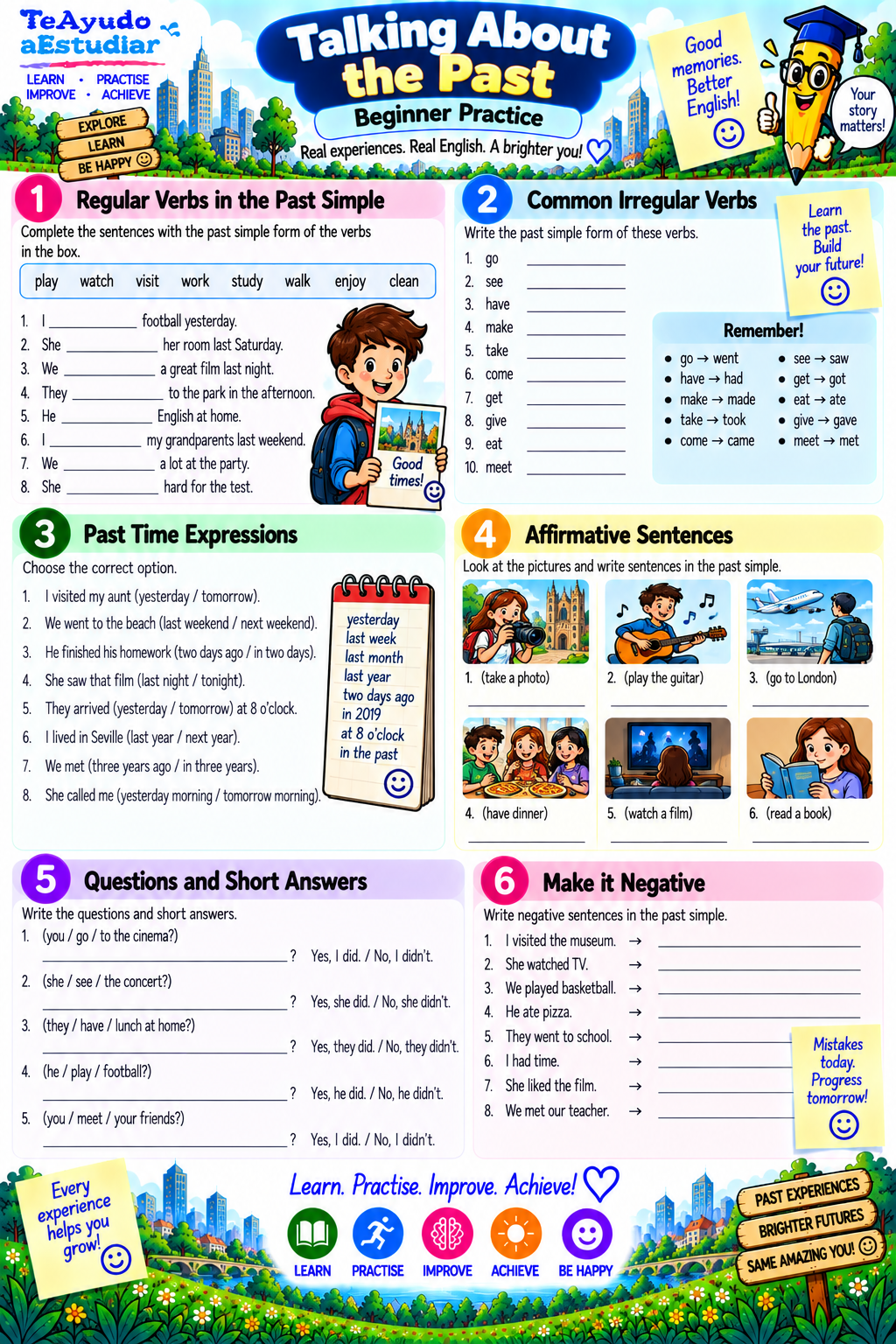
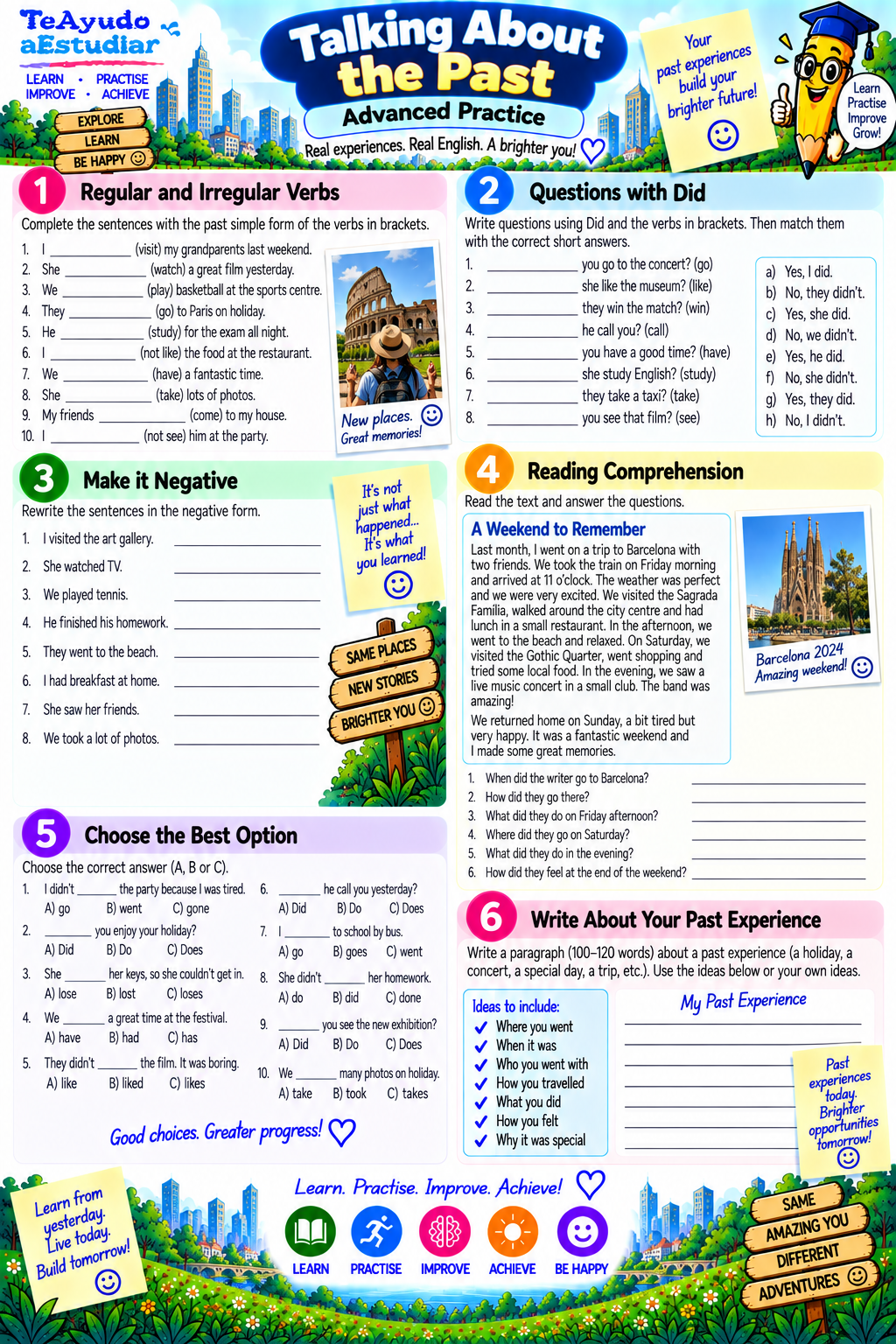
Fichas descargables
📝 Resumen
En esta lección de inglés A2 aprenderás a hablar de acciones y acontecimientos que ocurrieron en el pasado utilizando el Past Simple. Practicarás verbos regulares e irregulares, expresiones de tiempo como yesterday, last week y two days ago, y aprenderás a formar preguntas y frases negativas con did y didn’t. A través de ejemplos, una lectura original, juegos y actividades de escritura, podrás contar en inglés qué hiciste y qué ocurrió en diferentes momentos del pasado.
Recursos Premium Próximamente
Materiales más completos para aprender, practicar y avanzar.
Descubre nuestros cuadernos, packs de fichas y materiales exclusivos, creados para profundizar en cada asignatura y trabajar de forma autónoma.
Cuadernos educativos
Teoría, ejercicios y actividades organizadas para aprender paso a paso
Desde 4.90 €
Packs de fichas
Cientos de fichas listas para imprimir, organizadas por asignaturas y cursos.
Desde 1.99 €
Recursos Premium
Material exclusivo de refuerzo y exámenes con soluciones
Desde 1.99 €
¿Quieres aprender más rápido?
Suscríbete gratis a nuestra newsletter con el código QR o haciendo clic en el botón rojo y recibe recursos educativos, ejercicios, exámenes…
Sin spam. Cancela cuando quieras.

TeAyudoAEstudiar
Plataforma educativa para Primaria, ESO y docentes.
Asignaturas
Matemáticas
Inglés
Lengua
Ciencias Sociales
Recursos
Fichas
Exámenes
Juegos educativos
Recursos Premium
Empresa
Sobre nosotros
Aviso legal
Privacidad
Contacto
© 2026 TeAyudoAEstudiar · Todos los derechos reservados.
Creado por docentes🧡 para ayudarte a aprender.