
LESSON 06: WHAT WILL HAPPEN?

Let’s talk about what will happen! 🔮
🎯 WHAT WILL YOU LEARN?
By the end of this lesson, you will be able to:
- talk about the future using will
- make simple predictions about the future
- use will and won’t in affirmative and negative sentences
- ask and answer questions with Will…?
- use expressions such as I think, I don’t think, maybe and probably
- make simple predictions about your life and the world
Ready? Let’s imagine the future! 🚀
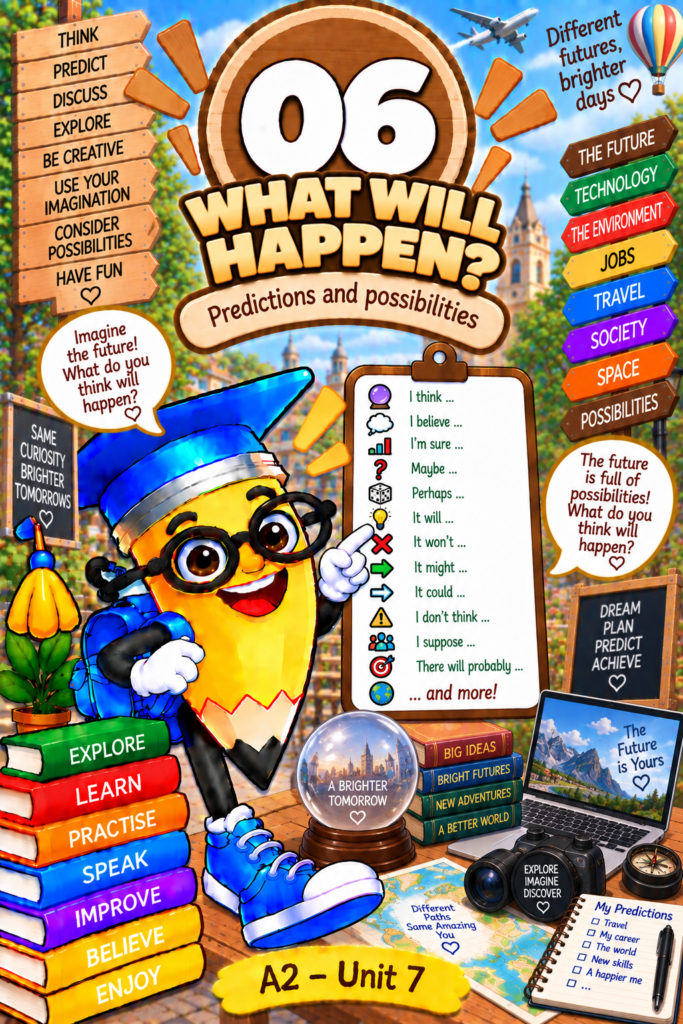
🔮 WHAT WILL HAPPEN?
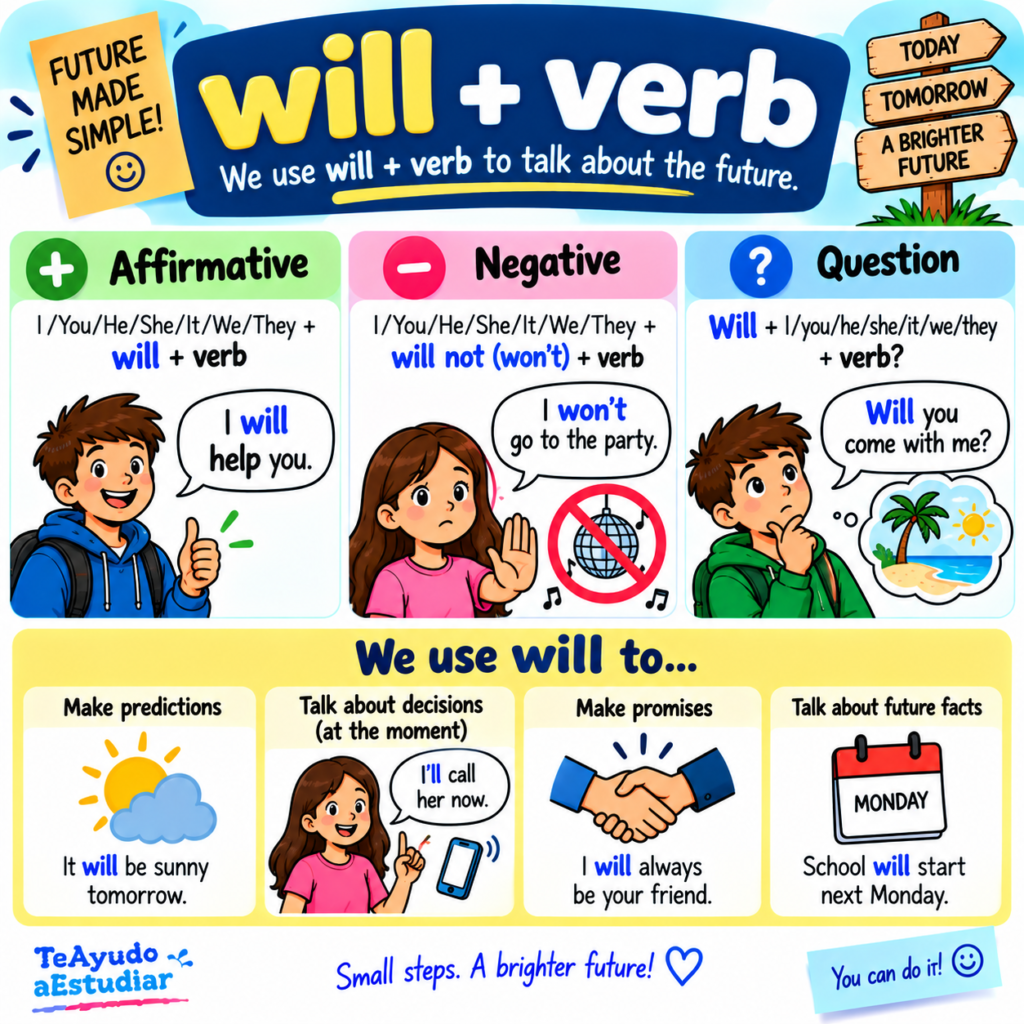
We use will + verb to talk about the future. At A2 level, one important use is making a prediction about what we think will happen.
| Subject | Example |
|---|---|
| I | I will travel more in the future. |
| you | You will learn many new things. |
| he / she | She will have a great job. |
| we | We will live in a different world. |
| they | They will visit many countries. |
The verb after will stays in its basic form:
- will go ✅
- will travel ✅
- will study ✅
- will be ✅
Not: will goes ❌ or will went ❌.
💬 I THINK…
When we make a prediction, we often use expressions such as:
| Expression | Example |
|---|---|
| I think… | I think people will travel to Mars one day. |
| I don’t think… | I don’t think schools will disappear. |
| Maybe… | Maybe people will live on the Moon. |
| Probably… | People will probably use more technology. |
These expressions help us show that a prediction is our idea or opinion.
❌ WON’T
The negative form of will is will not or the shorter form won’t.
| Positive | Negative |
|---|---|
| People will travel more. | People won’t travel less. |
| She will be famous. | She won’t be famous. |
| We will have more technology. | We won’t have less technology. |
Won’t is very common in everyday English.
❓ WILL YOU…?
To ask a question about the future, put will before the subject.
| Question | Short answer |
|---|---|
| Will you travel next summer? | Yes, I will. / No, I won’t. |
| Will she be famous? | Yes, she will. / No, she won’t. |
| Will they live in another country? | Yes, they will. / No, they won’t. |
You can also use question words:
- What will you do?
- Where will you live?
- Who will you meet?
- When will you travel?
🌍 THE WORLD IN THE FUTURE
Look at these predictions. Do you agree?
- People will use more electric cars.
- Robots will help people at home.
- More people will work with computers.
- Technology will change schools.
- People will travel to new places.
- Some jobs will be very different.
There are no right or wrong answers when we make predictions about the future. What matters is explaining what you think.
🌟 TOMORROW’S WORLD
Read Leo’s predictions about the future.
Hi! I’m Leo and I love thinking about the future.
I think life will be very different in 2050. People will probably use electric cars everywhere, and some cars will drive themselves. I think robots will help people with some jobs at home, too.
Schools will probably use more technology. Students will learn with computers and tablets, but I don’t think teachers will disappear. Students will still need teachers to help them.
Maybe people will travel to the Moon for holidays one day. I don’t know if that will happen, but it sounds exciting!
What about you? What do you think the world will be like?
🔎 CHECK YOUR UNDERSTANDING
- What year is Leo talking about?
- What does he think people will use everywhere?
- What will some cars do?
- Who will help people with some jobs at home?
- Will teachers disappear?
- Where might people travel for holidays?
- Does Leo know if people will travel to the Moon?
🎯 WILL OR WON’T?
Complete the sentences with will or won’t according to your own ideas.
- In the future, people ______ travel more.
- Cars ______ use petrol forever.
- Robots ______ help people at home.
- Schools ______ change in the future.
- People ______ live on other planets.
- Technology ______ become more important.
There can be different answers. Explain your ideas using I think… or I don’t think….
💭 MY FUTURE
Now think about your own future.
- I think I will __________________.
- I think I will live __________________.
- I think I will work __________________.
- I think I will travel to __________________.
- I don’t think I will __________________.
- Maybe I will __________________.
Write 6–8 sentences about your future.
🔄 GOING TO OR WILL?
You’ve now learned two useful ways to talk about the future.
| Use | Example |
|---|---|
| going to — a plan or intention | I’m going to visit my grandparents. |
| will — a prediction or opinion | I think it will be a great day. |
Compare:
- I’m going to study tonight. → This is my plan.
- I think I’ll pass the exam. → This is my prediction.
Don’t worry if the difference feels difficult at first. The important thing is to understand the main idea and communicate your message.
🏆 A2 CHALLENGE
Welcome to 2050!
Imagine that you are writing a message to a friend from the year 2050.
- make at least 5 predictions using will or won’t
- use at least two expressions of opinion: I think, I don’t think, maybe, probably
- talk about technology, school, transport or everyday life
- include at least one prediction about yourself
- write 8–10 sentences
Example: In 2050, I think people will use electric cars everywhere. Robots will probably help people at home. Schools will use more technology, but teachers will still be important. Maybe people will travel to the Moon. I don’t think everyone will work in an office. I think I will live in a big city and I will travel a lot.
🎮 GAMES — WHAT WILL HAPPEN?
Practise what you’ve learned! Try these games and practise talking about future predictions.
¿Qué verbo va después de “will”?
Will es una forma que usamos para hablar del futuro. En esta lección la utilizamos principalmente para hacer predicciones: I think it will be sunny.
¿Cuál es la forma negativa?
La forma negativa es will not, normalmente contraída como won’t: I won’t go.
¿Cómo hago una pregunta con “will”?
Colocamos will antes del sujeto: Will you travel next year?
¿Qué diferencia hay entre “will” y “going to”?
En esta unidad, piensa principalmente en going to para planes e intenciones y en will para predicciones: I’m going to study tonight / I think I’ll pass the exam.
¿Qué significa “I think”?
I think significa “creo que” o “pienso que”. Es muy útil para introducir una opinión o una predicción: I think it will rain.
¿Puedo usar “maybe” con una predicción?
Sí. Maybe significa “quizás” y normalmente aparece al principio: Maybe people will live on Mars.
¿Mis predicciones tienen que ser verdaderas?
No. Una predicción es una idea sobre el futuro. Lo importante es utilizar correctamente el inglés para expresar lo que piensas.
📥 Fichas descargables
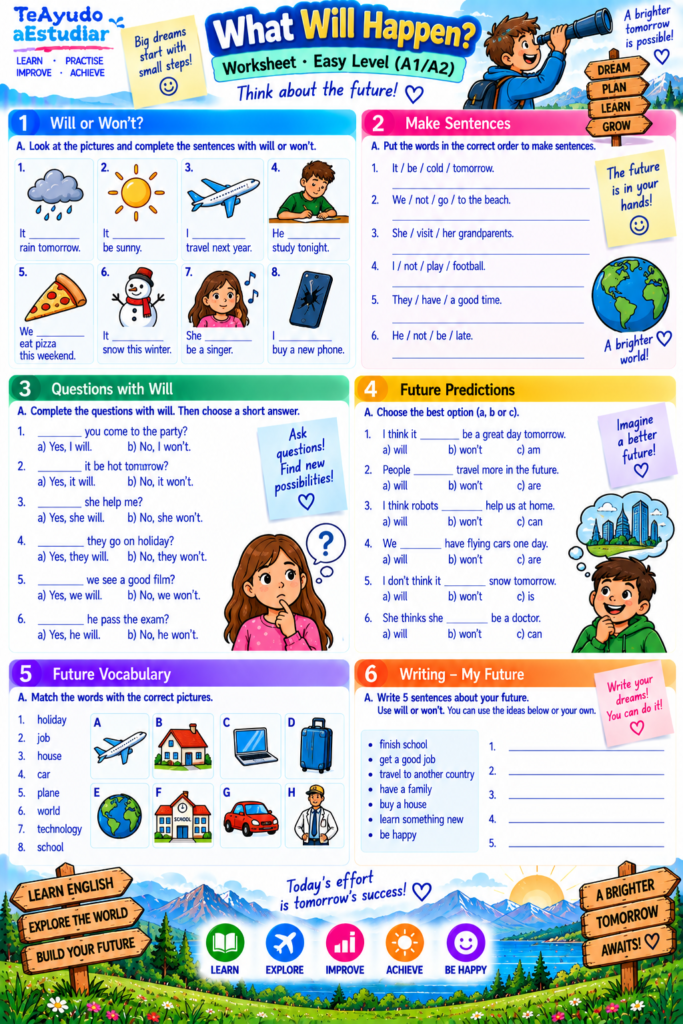

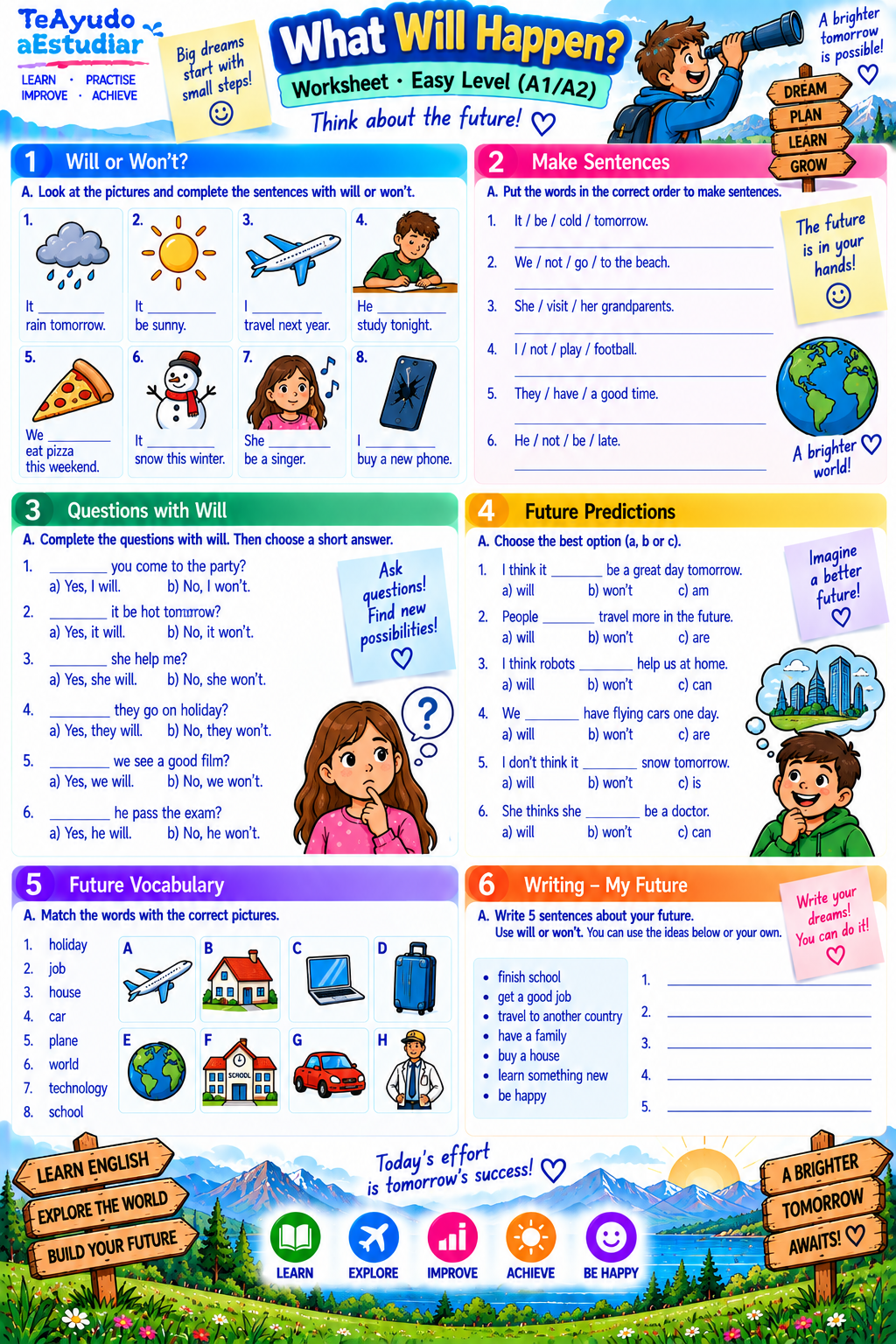
📝 Resumen
En esta última lección de la unidad de inglés A2 aprenderás a hablar sobre el futuro y hacer predicciones utilizando will y won’t. Practicarás cómo expresar opiniones con estructuras como I think, I don’t think, maybe y probably, además de formular preguntas sobre el futuro. También compararás de forma sencilla will y going to: going to para planes e intenciones y will para predicciones. Con una lectura original, juegos y actividades de producción podrás imaginar cómo será tu vida y el mundo en el futuro.
Recursos Premium Próximamente
Materiales más completos para aprender, practicar y avanzar.
Descubre nuestros cuadernos, packs de fichas y materiales exclusivos, creados para profundizar en cada asignatura y trabajar de forma autónoma.
Cuadernos educativos
Teoría, ejercicios y actividades organizadas para aprender paso a paso
Desde 4.90 €
Packs de fichas
Cientos de fichas listas para imprimir, organizadas por asignaturas y cursos.
Desde 1.99 €
Recursos Premium
Material exclusivo de refuerzo y exámenes con soluciones
Desde 1.99 €
¿Quieres aprender más rápido?
Suscríbete gratis a nuestra newsletter con el código QR o haciendo clic en el botón rojo y recibe recursos educativos, ejercicios, exámenes…
Sin spam. Cancela cuando quieras.

TeAyudoAEstudiar
Plataforma educativa para Primaria, ESO y docentes.
Asignaturas
Matemáticas
Inglés
Lengua
Ciencias Sociales
Recursos
Fichas
Exámenes
Juegos educativos
Recursos Premium
Empresa
Sobre nosotros
Aviso legal
Privacidad
Contacto
© 2026 TeAyudoAEstudiar · Todos los derechos reservados.
Creado por docentes🧡 para ayudarte a aprender.